Think of Intelligent Automation (IA) as the difference between a simple calculator and an expert financial analyst. A calculator can do one thing perfectly, over and over. That's traditional automation. An analyst, on the other hand, doesn’t just crunch numbers—they learn from new data, spot trends, and help you make strategic decisions.
That’s what IA does for your business. It creates a team of "digital employees" that can think, learn, and handle complex, judgment-based work, not just the boring, repetitive stuff. It's the engine for truly scaling your operations, powered by skilled teams who know how to build and manage it.
The Real Engine for Scaling Your Business
Intelligent Automation changes the game by blending the raw power of Robotic Process Automation (RPA) with the brains of Artificial Intelligence (AI). Basic automation is all about following a strict set of rules, like a script. IA is different because it can learn and adapt.
This lets your business automate entire workflows that were previously off-limits—like reading and understanding invoices, making sense of customer emails, or making smart decisions on the fly without a human stepping in.
The market tells the story loud and clear. It's projected to hit USD 30.53 billion by 2035, growing at a healthy 10.5% clip each year. This isn't just hype; it's a global shift away from manual grunt work toward smart systems that can run the show, with North America leading the charge and grabbing up to 50% of the market.
To help you see the difference, here’s a quick breakdown:
Intelligent Automation vs Traditional Automation at a Glance
| Capability | Traditional Automation | Intelligent Automation |
|---|---|---|
| Data Handling | Structured data only (spreadsheets, databases) | Handles structured and unstructured data (emails, PDFs, images) |
| Decision Making | Follows strict "if-then" rules | Makes judgments based on context and learning |
| Process Scope | Automates simple, repetitive tasks | Manages complex, end-to-end workflows |
| Adaptability | Rigid; breaks when processes change | Learns and adapts to new situations and data |
| Cognitive Skills | None; pure execution | Employs AI for language, vision, and prediction |
This table makes it clear: IA isn't just a faster version of what you already have. It's a fundamentally new way to build a more resilient and intelligent business.
Building Your In-House Automation Capability
Getting started with IA isn't just about buying software. It's about building a skilled team that can turn technology into a competitive advantage. Success hinges on empowering your people to become the innovation engine.
Here are proven strategies to build that capability:
- AI-Adopted Engineer Placements: Accelerate your projects by embedding a skilled AI engineer directly into your team. They deliver immediate results while transferring critical knowledge to your existing staff.
- AI Team Augmentation: Flexibly scale your AI capabilities by bringing in experts on-demand. This is ideal for specific projects where you need specialized skills without the commitment of a full-time hire.
- Targeted AI Workshops: Empower your developers with hands-on training. Workshops focused on platforms like Weavy.ai or AI-powered coding tools like Cursor and Claude for dev teams can fundamentally transform productivity and innovation.
The big idea here is that IA lets you scale your business without having to scale your payroll. It’s about working smarter by embedding intelligence directly into your day-to-day operations.
Before you can really harness its power, you first have to understand what artificial intelligence in business entails. Think of AI as the "brain" that gives automation its decision-making superpowers.
Once you connect those dots, you start to see how all the pieces fit together. For a deeper look at how these technologies merge, check out our guide on what is intelligent process automation. This groundwork will set you up perfectly for everything that comes next.
Understanding the Core Components of IA
Intelligent Automation isn't one single piece of tech. It’s more like a dream team of different tools working in sync. The best way to think about it is like a highly skilled employee: they have hands to do the work, a brain to make decisions, and the ability to learn from their mistakes. IA is built on that same idea, blending pure execution with real intelligence.
The foundation is what I call the "digital hands"—Robotic Process Automation (RPA). RPA bots are the grinders, the workhorses built to copy human actions inside digital systems. They’re brilliant at logging into apps, copying and pasting data, filling out forms, and moving files around. But they need to follow a very strict set of rules.
That’s where the limitations kick in. RPA on its own can only handle predictable, structured tasks. This is where the "decision-making brain" comes into play: Artificial Intelligence (AI). AI is what gives automation the power to deal with exceptions, use judgment, and make sense of the messy, unstructured data that makes up most of our daily work.
This is how the two come together to create something truly powerful.
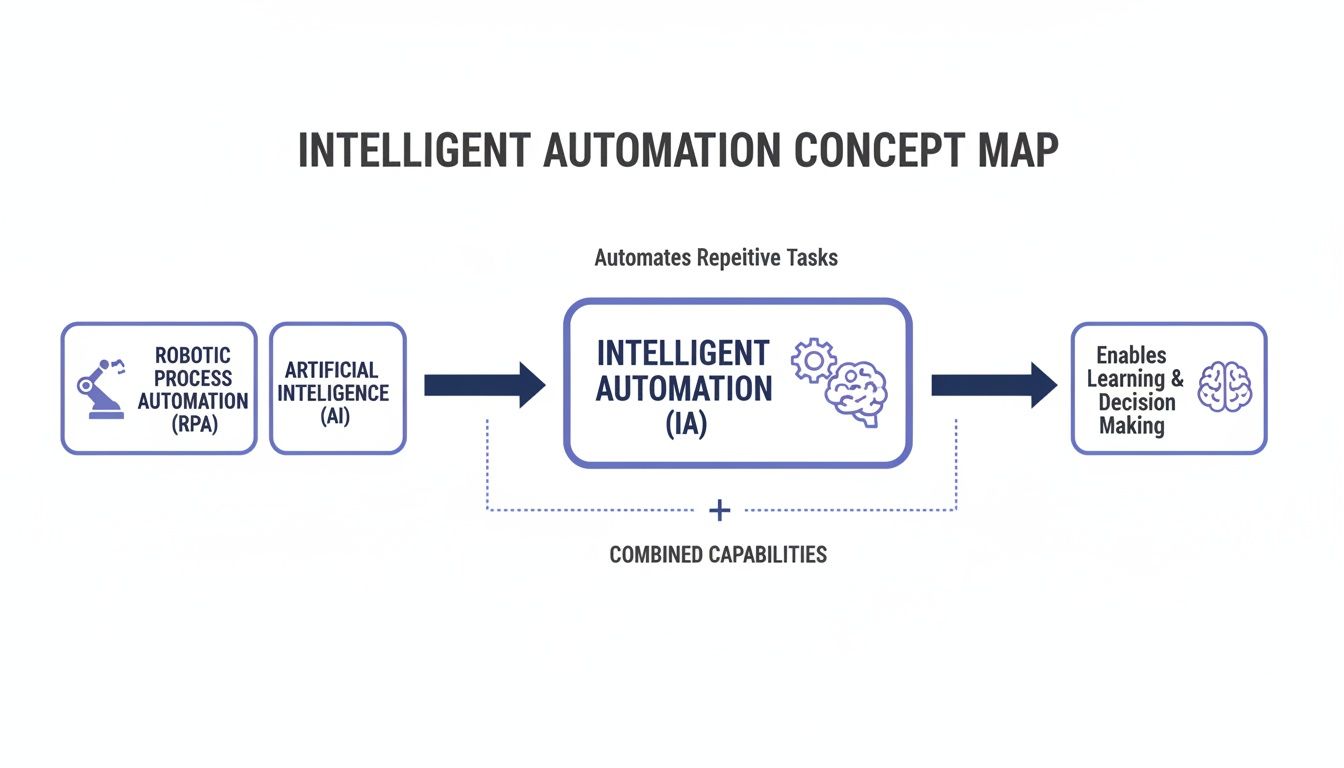
As you can see, RPA provides the action, and AI provides the thinking. This fusion is what lets a business move beyond just automating a single click to automating an entire, complex workflow from start to finish.
The Learning Engine: Machine Learning
Digging a bit deeper into the AI brain, we find Machine Learning (ML). This is the secret sauce that allows these systems to get smarter over time without a developer having to manually recode them. Just like an employee gets better and faster at their job with experience, ML algorithms sift through data to spot patterns, make predictions, and fine-tune their own performance.
A classic example is an ML model flagging fraudulent transactions. It learns by analyzing thousands of past examples, getting sharper and more accurate with every new data point it sees. This self-improvement is what makes IA so dynamic and valuable.
Enabling Human-Like Understanding
To really automate the tricky stuff, systems need to understand us—how we talk, how we write, and what we see. Two key pieces of AI make this a reality:
- Natural Language Processing (NLP): This is the tech that lets bots read and understand human language. It’s the magic behind an IA system that can process an angry customer email, pull the important details out of a support ticket, or classify a hundred documents just by reading their content.
- Computer Vision: This gives bots the ability to "see" and interpret images and videos. Think of it being used to pull text off a scanned invoice, identify a specific product in a photo, or even analyze a video feed on a factory floor for quality control. It turns visual noise into structured, actionable data.
By combining RPA's raw execution power with AI's cognitive skills like NLP and computer vision, you create a system that can handle unpredictable, real-world data and navigate complex workflows from start to finish.
The market is exploding because this combination works. The intelligent process automation space—a core part of IA—is projected to hit USD 37.54 billion by 2031, growing at a blistering 15.98% CAGR. RPA is still the foundational layer, holding a dominant 42.84% share in 2025, but look at process mining: it's growing at 26.4% CAGR as companies rush to map their workflows before they unleash the bots. You can dig into more of these intelligent process automation market trends to see where things are headed.
This synergy lets you build a truly scalable digital workforce. But remember, the tech is only as good as the human talent guiding it. Your team’s ability to implement and manage these tools is what will ultimately drive your success.
Putting Intelligent Automation to Work in Your Business
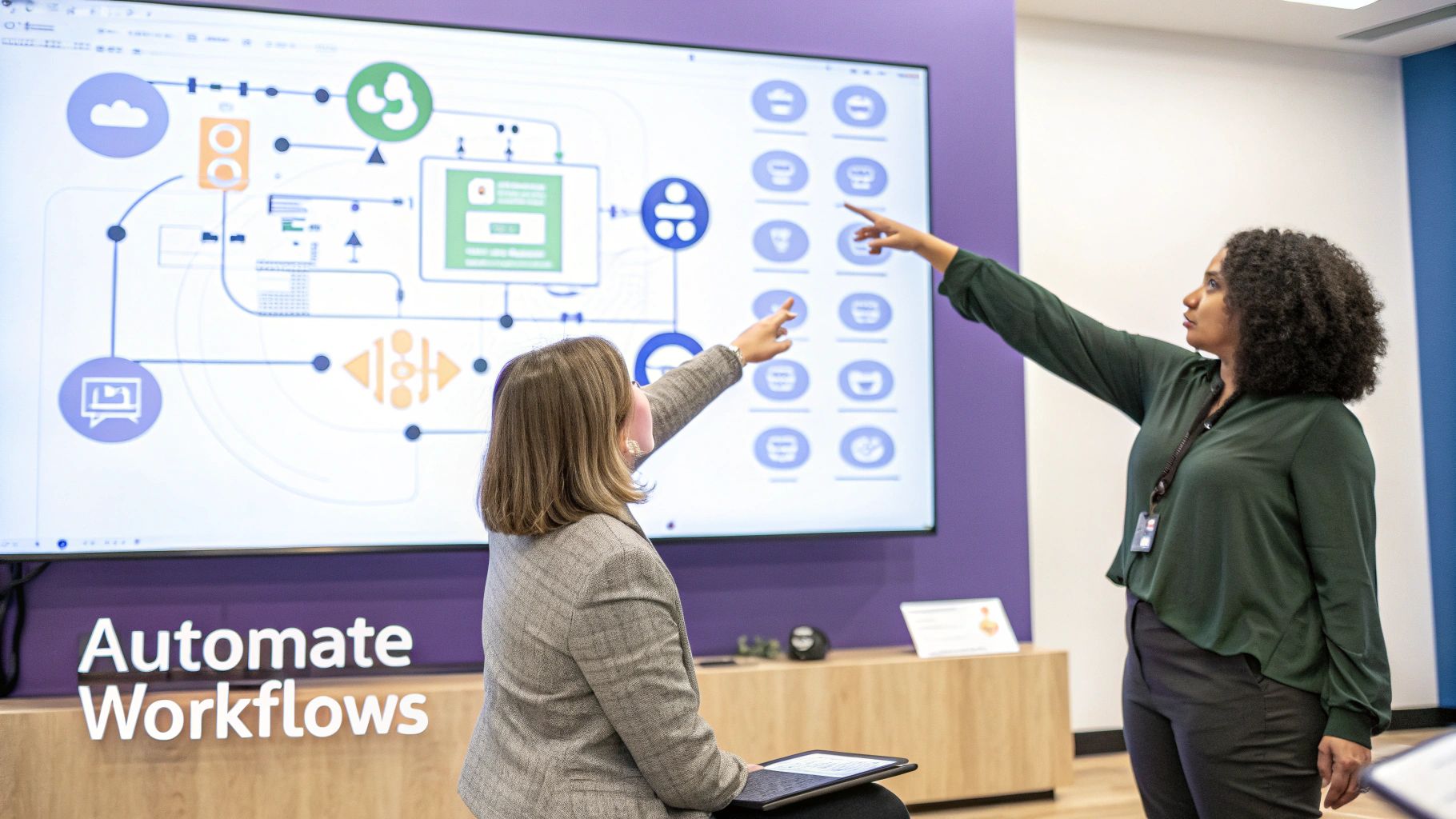
Knowing the theory behind intelligent automation is one thing, but seeing it solve real business headaches is where it all clicks. The real magic happens when you put it to work—turning abstract tech into concrete gains in how your business runs day-to-day.
Think of it as deploying a digital workforce that grinds away 24/7, handling the complex, repetitive stuff that used to eat up your team's precious time. This isn't just a game for Fortune 500 companies. For scaling businesses, it’s a direct path to growth without having to pile on headcount. The secret is simply knowing where to aim it first.
But here’s the reality: the tech is only as good as the people who build and manage it. Before you jump into specific use cases, you need a plan for building the internal muscle to support these systems. Without the right talent in-house, even the sharpest automation strategy will fall flat.
Building Your In-House Automation Expertise
Deploying sophisticated IA solutions demands a team that gets both the tech and your business goals. A lot of companies hit a wall here—they have a skills gap when trying to level up from simple automations to truly intelligent systems.
The good news is you don’t have to start from scratch. There are a few proven ways to bridge that gap.
-
AI-Adopted Engineer Placements: This is a fast-track approach. We embed a pre-skilled AI automation engineer right into your team. They don't just build your first projects; they mentor your people, transferring their knowledge and showing them the ropes. It’s like an accelerator for upskilling your own staff.
-
AI Team Augmentation: Maybe you just need a specialist for a single, complex project or want to scale up automation efforts without the long-term hiring commitment. Team augmentation is perfect for this. You can bring in expert developers or AI architects on-demand to crack tough problems, getting the right skills exactly when you need them.
-
Targeted AI Workshops for Developers: Often, the most sustainable path is empowering the team you already have. We run custom workshops focused on giving your developers the tools they need. Training on AI-powered coding assistants like Cursor or large language models like Claude can make them exponentially more effective. Similarly, workshops on platforms like Weavy.ai can teach them how to build intelligent features directly into your own applications.
By investing in your team’s skills—whether through placements, augmentation, or direct training—you’re building a self-sustaining engine for innovation. This ensures your company can not only implement IA today but also adapt and expand its use as you grow.
Solving Key Business Bottlenecks with IA
Once your team is ready, you can start pointing this technology at your biggest operational bottlenecks. Intelligent automation is a beast at fixing the frustrating slowdowns that happen across departments, from sales and marketing to ops and customer support.
Take sales teams, for instance. They often get buried in manually qualifying hundreds of inbound leads. It's a massive time sink, and good prospects inevitably slip through the cracks. IA can flip that entire workflow on its head.
-
Automated Lead Qualification: Imagine an AI agent that analyzes every inquiry from your web forms, emails, and chatbots. Using Natural Language Processing (NLP), it can understand a prospect's needs, budget, and urgency, then score and route only the hottest leads straight to your sales reps.
-
Personalized Prospect Nurturing: As soon as a good lead is identified, another workflow can kick in, sending personalized follow-up emails, relevant case studies, or resources based on what that prospect actually cares about. This keeps them warm and engaged without anyone on your team lifting a finger.
This is what a smart application of IA does. It frees your sales team to focus on what humans do best: building relationships and closing deals. Once you understand how to automate business processes like this, you start unlocking some serious gains in both efficiency and revenue.
How to Implement Intelligent Automation Successfully
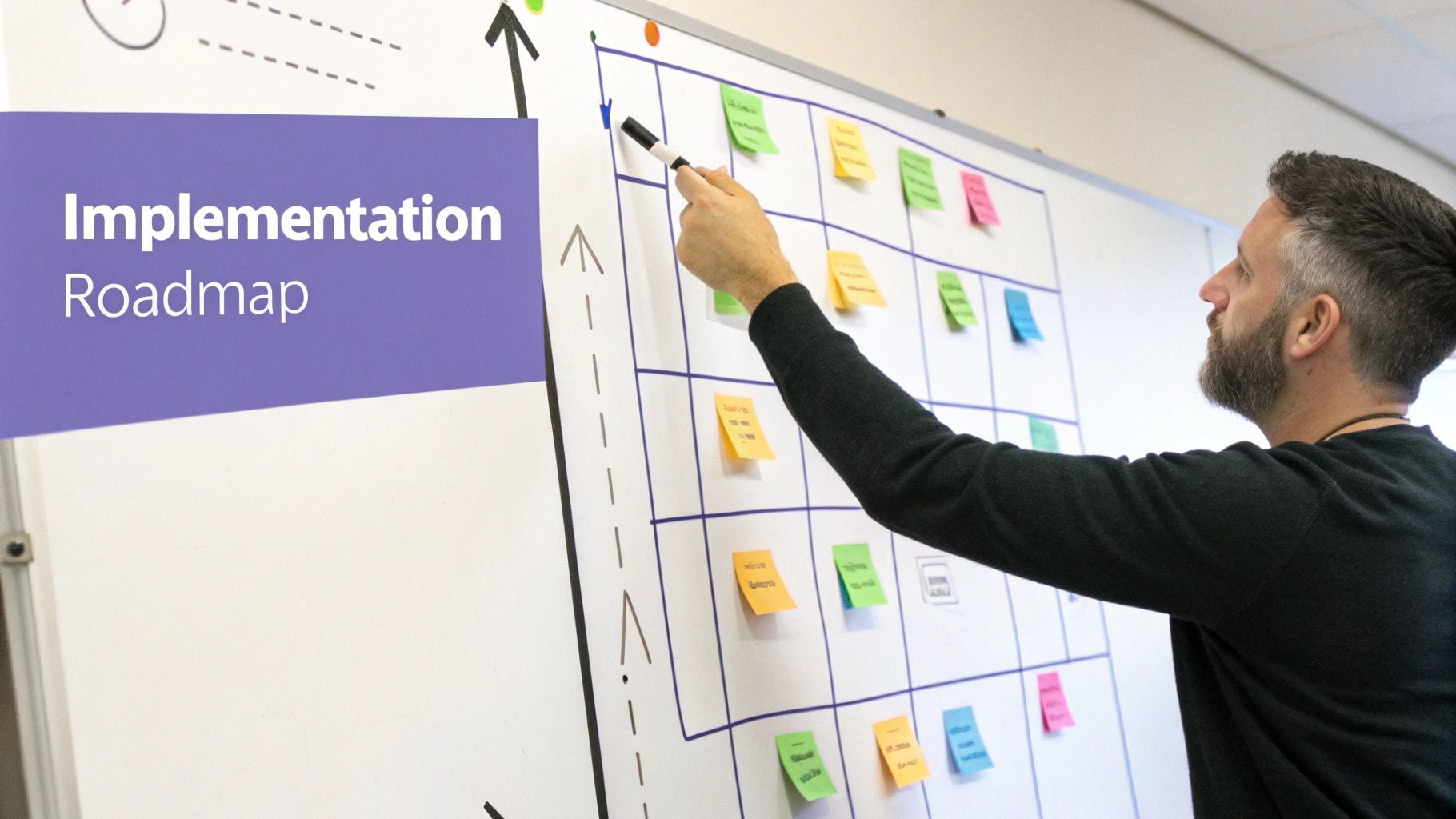
Jumping into intelligent automation isn’t about buying a single piece of software and hoping for the best. It's about building a genuine capability inside your organization. While a clear roadmap is critical, even the best plans fall apart without the right people to make them happen.
Before you start auditing processes or debating tech stacks, the first real step is making sure your team is ready for the challenge. This is where so many businesses stumble. They dive in headfirst, only to find out their existing teams don't have the specialized skills to build and manage these complex, AI-driven systems.
Closing that talent gap is the real foundation for success. It’s what separates a pilot project that fizzles out from an automation engine that truly drives growth. Think of building your in-house talent as step zero—the one you absolutely can't afford to skip.
Build Your In-House Automation Engine
To really get the most out of intelligent automation, you need a crew that can do more than just deploy solutions. You need people who can innovate and adapt them as your business changes. The good news? You don't have to spend months on a traditional hiring spree. There are much faster, more effective ways to get the expertise you need.
It’s about strategically injecting the right talent and knowledge directly into your company. This approach not only gets you moving faster but also helps create a self-sustaining culture of automation.
Here are three proven ways to build a world-class AI and automation team from within:
-
AI-Adopted Engineer Placements: This is your fast track. By embedding a pre-skilled AI automation engineer directly into your team, you get immediate firepower to start building. Even better, they act as a mentor, passing on crucial knowledge and best practices to your current staff through hands-on work.
-
AI Team Augmentation: This flexible model lets you tap into specialized skills exactly when you need them. Need a machine learning guru for a tricky algorithm or a senior architect to design a scalable system? Augmentation lets you scale your team's skills up or down without the overhead of permanent hires.
-
Targeted AI Workshops: The most sustainable long-term play is empowering your current developers. Custom workshops focused on practical tools can completely change your team's productivity. Training on AI coding assistants like Cursor or large language models like Claude can dramatically shrink development cycles. Likewise, workshops on platforms like Weavy.ai can teach them how to weave intelligent features directly into your core apps.
Building a skilled team isn't just a box to check off; it's the central pillar of a successful intelligent automation strategy. This investment ensures you can not only implement solutions today but also innovate and scale them for years to come.
The momentum behind this technology shows why having a clear plan is so urgent. The intelligent automation market is expected to explode from USD 10.593 billion in 2021 to an estimated USD 51.575 billion by 2033. North America is leading the charge with a projected 39.20% market share by 2025, proving that early, strategic adoption—powered by skilled teams—creates a massive competitive advantage.
A Practical Four-Step Implementation Framework
Once your team is ready to go, you can move forward with a structured plan. This roadmap ensures you start with high-impact wins and build a solid foundation you can grow from.
-
Discovery and Audit: The journey starts by finding the right opportunities. The goal is to pinpoint high-impact, low-complexity processes—the quick wins. Look for tasks that are repetitive, rule-based, and prone to human error. You'll often find these hiding in plain sight in finance, HR, or operations.
-
Strategy and Design: With your target processes locked in, the next move is to design a scalable architecture. This means picking the right tech stack that plays nicely with your existing systems and designing workflows that are both efficient and tough enough to handle real-world chaos. For a deeper look at this, check out our guide on how to implement AI in business.
-
Implementation and Integration: This is where the plan becomes reality. Your team will develop and deploy custom AI agents and bots, connecting them to your existing applications through APIs and other integrations. A smooth implementation hinges on adopting best practices like those found in DevOps for Machine Learning to keep things efficient and reliable.
-
Optimization and Scaling: Launching is just the beginning. The final phase is all about continuous monitoring, refining algorithms, and gathering feedback to make the system smarter. Once you demonstrate clear ROI, you can strategically expand automation to other departments, scaling the benefits across the whole organization.
Building Your In-House AI and Automation Talent
Great automation isn’t built on powerful software alone—it’s built by skilled people. While the right tech stack is a huge piece of the puzzle, it’s the talent behind the tools that actually turns potential into real business results. Without a team that gets how to design, deploy, and tweak intelligent systems, even the most exciting projects can fizzle out.
This is exactly why building up your internal skills is non-negotiable. Before you can scale complex workflows, you have to know you have the right expertise in-house. Investing in your team is like building a self-sustaining engine for growth, letting you adapt and expand your automation efforts for years to come.
Lots of companies hit a wall when they try to jump from basic scripts to truly intelligent systems. The good news? You don’t have to get stuck in a months-long hiring slog to find the right people. There are much faster, more direct ways to build a team that’s ready for anything.
AI-Adopted Engineer Placements
One of the quickest ways to get your intelligent automation efforts into high gear is with AI-Adopted Engineer Placements. The idea is simple: we embed an experienced, pre-vetted automation engineer directly into your team. Think of it as a talent transplant that starts delivering value from day one.
This expert doesn’t just work on their own island. They become part of your crew, leading the first few projects, solving tough technical problems, and—most importantly—passing their knowledge straight to your employees. Through daily collaboration and hands-on mentorship, your team soaks up best practices in real-time, building the internal muscle to manage and scale your automation ecosystem.
This approach lets you skip the painful learning curve, giving you immediate project momentum while upskilling your own staff for the long haul. It's the perfect play for companies that need to move fast but also want to build sustainable skills.
Flexible AI Team Augmentation
What if you need highly specialized skills for a specific project but don't want the long-term overhead? AI Team Augmentation is the answer. This model gives you on-demand access to top-tier automation talent to support your internal team and get critical projects over the finish line.
Imagine you need a machine learning pro for a new predictive analytics model or a senior architect to design a secure, scalable infrastructure. Augmentation lets you bring these specialists in for the exact time you need them, whether it's a few weeks or several months. It gives you the agility to take on ambitious goals without the commitment of another full-time hire.
This on-demand model ensures you always have the right expertise at the right time. It's a smart, cost-effective way to de-risk complex projects and give your team the expert backup they need to win.
Empowering Your Team with AI Workshops
Perhaps the most durable strategy for long-term success is simply making the developers you already have even better. Targeted AI Workshops can transform your existing engineering team into an in-house innovation powerhouse by arming them with the latest, most effective tools and techniques.
These aren’t your typical, yawn-inducing training sessions. We’re talking about custom, hands-on workshops focused squarely on practical application. The goal is to make your developers wildly more efficient and capable of building sophisticated automation.
Common workshop topics that deliver huge wins include:
- AI-Powered Coding Assistants: We get your team fluent in tools like Cursor to help them write, debug, and refactor code in a fraction of the time. Development cycles get shorter. It’s that simple.
- Advanced Language Models: Workshops on interacting with models like Claude teach your dev teams how to tackle complex problems, autogenerate documentation, and build the sophisticated logic needed for powerful AI agents.
- Platform-Specific Training: We run deep-dive sessions with platforms like Weavy.ai to show your developers how to build intelligent features and automated workflows directly into your company’s applications.
By investing in targeted training, you’re not just teaching new skills. You’re cultivating a culture of constant improvement and innovation that pays dividends across the entire organization.
Got Questions About Intelligent Automation? We've Got Answers.
Diving into a new technology always brings up questions. It's only natural. Getting a solid handle on what intelligent automation really is—and what it isn’t—is the first step to building a strategy that actually works. We hear these questions all the time from founders, CTOs, and ops leaders, so let's clear them up.
How Is Intelligent Automation Different From RPA?
Great question. Think of Robotic Process Automation (RPA) as a digital worker that's great at following a very specific, pre-written script. It can copy-paste data, fill out forms, and move files—basically, it's the 'hands' doing repetitive, manual work.
Intelligent Automation (IA) is what happens when you give those hands a 'brain.' By layering AI on top of RPA, the system can now think, learn, and make decisions. Instead of just mindlessly copying data from one invoice format, it can now read and understand 100 different formats, figure out the context of a customer email, and handle exceptions without needing a human to step in. It’s a massive upgrade in capability.
How Does This Integrate With My Existing Systems?
This is a big one. Nobody wants to rip and replace their entire tech stack. The good news is, you don’t have to.
Modern IA platforms are built to play nice with what you already have. They act as a flexible layer on top of your current tools, using APIs and smart UI interactions to connect with everything from ancient legacy software to the latest cloud apps. It's a non-invasive approach, meaning you don't need a massive, risky overhaul. A good partner will make sure these integrations are rock-solid, secure, and built to grow with you.
What Is the Best First Step to Getting Started?
Don't try to boil the ocean. The smartest way to start is by picking a process that is high-impact but low-complexity.
Look for the bottlenecks in your business—the tasks that are tedious, repetitive, and a magnet for human error. You'll often find them in finance (think invoice processing) or HR (employee onboarding is a classic). Nailing a small, well-defined project first delivers a quick, undeniable ROI. That win builds the momentum you need to tackle bigger, more complex automation challenges down the road.
From there, it's all about building on that success. You can strategically bring in talent through AI-adopted engineer placements or level up your existing team with practical AI workshops on tools like Cursor and Claude. This creates a powerful, self-sustaining engine for scaling automation across the entire business.
Ready to see how intelligent automation can help you scale without just throwing more people at the problem? AY Automate offers a complimentary automation audit to pinpoint your best opportunities. Schedule your free consultation today!