To truly scale content creation, you have to stop thinking about adding more people and start building an intelligent system—one powered by AI and smart automation. This is about more than just writing tools; it’s about implementing custom AI agents, redesigning your workflows, and bringing in specialized AI talent through AI team augmentation and AI adopted engineers placements to augment your team.
The goal? A cost-effective, self-improving content engine that lets your team focus on strategy, not repetitive grunt work.
Rethinking Content Creation at Scale

The old playbook for scaling content—just hiring more writers, designers, and marketers—is officially broken. It’s painfully slow, shockingly expensive, and creates a mess of operational bottlenecks that kill momentum. Founders and CTOs are catching on: genuine scale doesn't come from headcount. It comes from building an efficient, automated 'Content Operating System.'
This isn't just about getting a subscription to the latest AI writer. It's about architecting a cohesive system where AI agents and clever automation handle the heavy lifting. This frees up your human talent for the high-impact strategic work that actually moves the needle. This guide is your blueprint for building that exact system from the ground up.
The New Foundation of Content Scale
At its heart, this new model is built on a few core pillars. We're moving away from a "more is more" mentality and toward producing content smarter and faster, with a clear connection to business goals. This isn't about replacing human creativity; it's about amplifying it with intelligent systems.
Here’s what that shift looks like in practice:
- AI Team Augmentation: Embedding engineers who live and breathe AI directly into your existing teams to speed up tech adoption and build custom solutions.
- AI Adopted Engineers Placements: Strategically placing full-time AI engineers within your teams to build long-term, in-house AI capabilities.
- Specialized AI Workshops: Running targeted training for your teams on high-impact tools like Cursor for developers or Weavy.ai for creatives.
- Custom AI Agent Deployment: Building and launching AI agents designed to own specific, repeatable tasks in your content process—from initial research to final distribution.
For instance, a development team could join an AI workshop focused on using tools like Cursor and Claude for code generation. This immediately standardizes their workflow and boosts productivity. This kind of focused training ensures the tech is actually used to its full potential, not just sitting on a shelf.
True scalability is achieved when your systems do the work, not just your people. By augmenting your team with AI expertise through placements and targeted training, you build an internal capability that pays dividends long after the initial setup.
From Manual Labor to Intelligent Systems
Making this jump requires a fundamental mindset shift. You stop asking, "Who can we get to do this?" and start asking, "How can we automate this process?"
This is where AI team augmentation becomes so critical. By placing AI-savvy engineers directly within your content or development teams, you close the knowledge gap and put implementation on the fast track.
These embedded experts become catalysts for change. They spot opportunities for automation and build the integrations to make it happen. One week they might help you run a workshop on a tool like Weavy.ai to improve creative collaboration; the next, they're helping you implement a secure, self-hosted LLM. This hands-on approach ensures the new systems are woven directly into your daily operations, creating a content engine that's built to last and designed to scale.
Building Your AI-Powered Content Architecture
Let's be honest: just subscribing to a few popular AI tools isn't a strategy. That’s a recipe for siloed workflows and wasted potential. To truly scale content, you need to think like an engineer and build a solid architecture—an integrated, secure tech stack that works as a single, cohesive machine.
The aim here is to create a seamless pipeline, from the first spark of an idea all the way to distribution, with automation oiling the gears at every stage. This isn't about buying more software; it's about making deliberate choices, from the core Large Language Models (LLMs) to the specialized tools your team will live in every day.
Selecting the Right Foundational Models
Everything starts with the "brain" of your operation: the LLM. While public models are impressive, most enterprises I work with need far more control, especially around security. This is where private or self-hosted instances of models like Claude or Gemini aren't just a nice-to-have; they're essential for protecting sensitive company data.
Picking the right model is a balancing act. You need to weigh a few key things:
- Security Needs: If you're in a regulated industry or have strict compliance rules, a self-hosted LLM running on your own infrastructure is non-negotiable. Full stop.
- Task Specialization: Is your team writing creative blog posts or analyzing data? Some models are poets, others are mathematicians. Match the model to your most critical content tasks.
- Integration Capability: The model has to play nice with your other systems. Check for robust APIs—this is crucial for building out any real automation.
For your developers, this thinking extends to their coding assistants. I’ve seen huge productivity gains from teams that run AI workshops to standardize on specific tools like Cursor or using Claude for code for dev teams. It gets everyone on the same page, operating from a consistent, efficient playbook instead of a dozen different fragmented approaches. A great first step is simply getting a lay of the land by exploring the best AI content generators to see what's out there.
Integrating with Automation and Collaboration Platforms
An LLM on its own is powerful, but it's a bit like an engine without a car. To get it moving, you need to connect it to automation platforms like n8n or Make. These tools are the central nervous system of your content engine. They link all your different apps and trigger automated workflows, often without needing a single line of custom code.
Imagine this: a new task is created in your project management tool. Instantly, Make triggers your LLM to draft a detailed article outline, which then gets posted in a specific Slack channel for the content team to review. That’s the kind of efficiency we're talking about.
Collaboration tools are the other piece of the puzzle. For creative and dev teams, integrating a platform like Weavy.ai can be a game-changer. It brings feedback loops and asset management directly into the apps they already use, killing the constant context-switching that absolutely tanks productivity.
The real power isn't in any single tool, but in the connections between them. A well-designed architecture ensures data and instructions flow effortlessly, turning a collection of apps into a cohesive, automated machine.
The Role of AI Team Augmentation
Look, building this kind of sophisticated architecture isn't a simple plug-and-play job. It demands specialized skills in both AI and engineering. This is why AI team augmentation and AI adopted engineers placements have become such potent strategies for the companies I advise. By embedding AI-savvy engineers directly into your teams, you don't just speed up the process—you transform it.
These embedded experts fill a few critical roles:
- They Bridge the Skill Gap: They have the deep technical know-how to implement custom integrations and get those secure, self-hosted LLMs up and running.
- They Spot Hidden Opportunities: By working shoulder-to-shoulder with your content and development teams, they can identify workflow bottlenecks you didn't even know you had and design custom automations to fix them.
- They Champion Adoption: They become your internal coaches, running AI workshops on tools like Cursor or Claude and offering hands-on support to make sure everyone knows how to actually use the new tools effectively.
This isn't about outsourcing a project; it's about building a permanent, internal capability. It’s how you ensure your big investment in technology actually pays off in real-world productivity. Whether you’re looking to enhance your current setup or build from scratch, you can learn more about the different options by exploring our guide on top generative AI consulting services. This smart mix of technology and talent is the absolute key to building a content architecture that doesn't just work today, but scales with your business tomorrow.
Designing Automated Content Workflows That Work
Once you've sorted out your AI architecture, you have the foundation. Now it's time to build the engine—the automated workflows that will actually scale your content creation. This isn't just about plugging in a few simple automations. It’s about designing a system of custom AI agents that execute specific, high-value content tasks with absolute precision.
Think bigger than just drafting articles. Imagine an AI agent that scans your performance marketing data, pinpoints the top-performing ad concepts, and then automatically generates a detailed creative brief for your next campaign. Or another that takes an approved outline and drafts a technical blog post, complete with formatted code snippets, all while adhering to your brand guidelines.
This is the kind of system we're aiming for. The diagram below shows how the core models, automation layers, and developer tools all fit together.
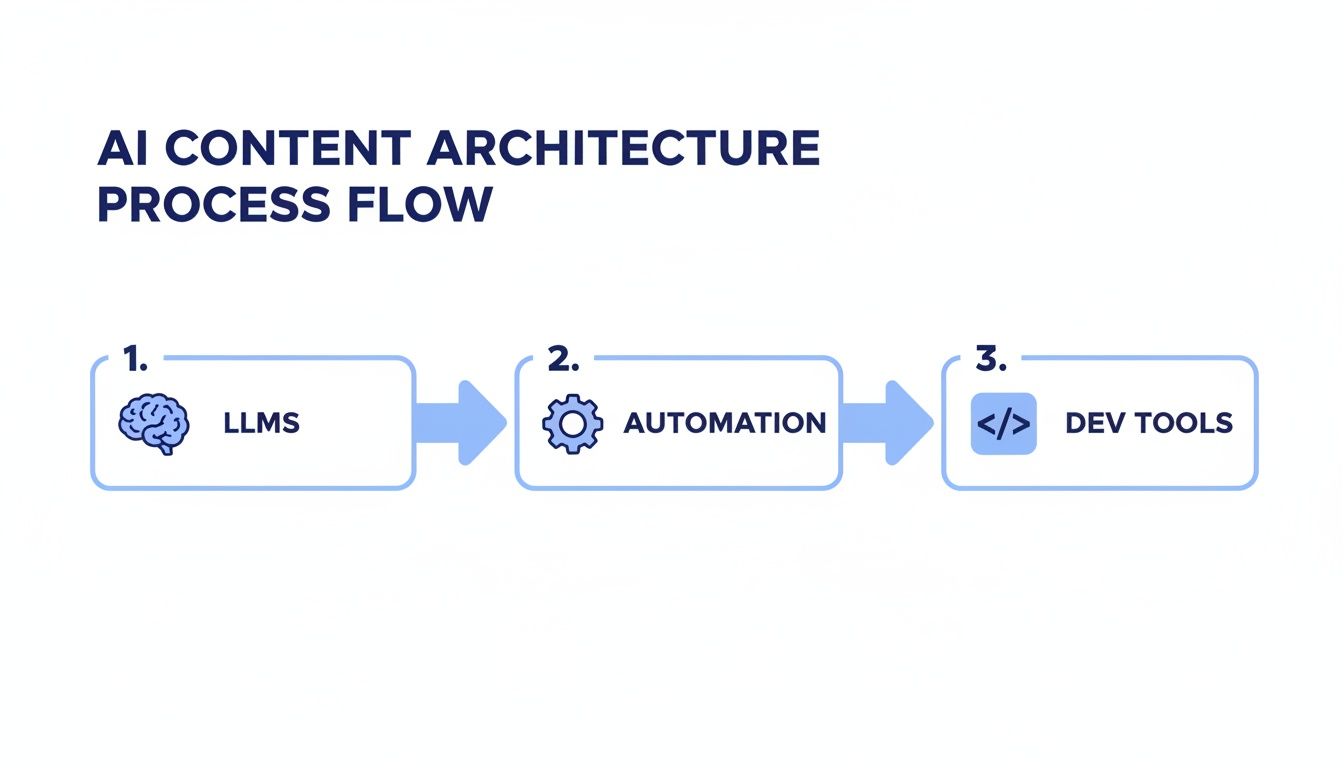
The key takeaway here is that real automation happens when your LLMs are wired into the rest of your tech stack. It's about creating a seamless operational loop.
The Power of AI Team Augmentation in Workflow Design
Building these kinds of sophisticated workflows requires a unique mix of skills: you need deep marketing knowledge, a knack for process optimization, and solid technical AI expertise. This is exactly where AI team augmentation comes into play. By embedding AI-savvy engineers directly into your content or marketing teams, you can build and refine these custom workflows much, much faster.
These specialists are translators. They turn your team’s strategic goals into functional, automated processes. They get both the marketing objective and the technical side, enabling them to build custom agents that solve real-world problems. For instance, they could connect your ad platform's API to your LLM, building a system that not only generates ad copy but also launches the A/B tests automatically.
This approach makes sure your automations are not just technically sound but are directly tied to your business goals.
The best content workflows aren't just automated; they're intelligent. They create a self-improving loop where performance data from one cycle directly informs the creative output of the next, constantly optimizing for better results.
A Real-World Scenario: Creative Testing at Scale
Let’s get practical. Think about a growth marketing team that needs to test hundreds of ad creative variations across multiple platforms. Done manually, this is a total nightmare of spreadsheets, repetitive design work, and endless data entry.
With an automated workflow, the whole process changes:
- Smart Brief Generation: The system analyzes past performance data to identify winning elements—like specific CTAs, visual styles, or headline formulas.
- Automated Asset Creation: An AI agent uses this brief to generate dozens of image and copy variations, making sure each one is on-brand and tailored to the platform.
- Hands-Off Launch: The new creatives are automatically pushed to the ad platforms via an API, with campaigns perfectly structured for rigorous A/B testing.
- Real-Time Feedback Loop: As performance data rolls in, the system analyzes it, pausing underperformers and shifting budget to the winners. This data then feeds right back into the brief for the next creative cycle.
This isn't just about speed. It’s about building an intelligent system that learns and adapts on its own, turning creative testing from a quarterly headache into a continuous, self-optimizing machine.
The productivity gains from this shift are massive. The table below shows just how much time you can save on common tasks.
Manual vs. AI-Augmented Content Workflow Comparison
| Content Task | Manual Process (Avg. Hours) | AI-Augmented Workflow (Avg. Hours) | Productivity Gain |
|---|---|---|---|
| Ad Creative Variation | 16 | 2 | 8x |
| SEO Blog Post Drafting | 8 | 1.5 | ~5.3x |
| Social Media Campaign | 10 | 1 | 10x |
| Performance Report | 5 | 0.5 | 10x |
As you can see, we're not talking about small improvements. Adopting these workflows gives teams back dozens of hours, which they can then reinvest in higher-level strategy instead of getting bogged down in repetitive tasks. Industry data backs this up: 80% of marketers are expected to use AI for content creation by 2026.
Building Competence Through Targeted AI Workshops
To make these workflows actually stick, your team needs to be fluent in the tools that power them. This is why AI workshops are non-negotiable. And I don’t mean generic, one-size-fits-all training. I’m talking about highly focused sessions centered on the specific tools your teams will use every single day.
- For your developers, this might be an AI workshop on standardizing code generation and review using tools like Cursor and Claude.
- For your marketers, it could be an advanced session on prompt engineering or a Weavy.ai workshop focused on AI-assisted creative collaboration.
These workshops ensure your team not only understands how to use the tools but why they fit into the larger strategic picture. To take it a step further, you'll also want to explore the broader ecosystem of content marketing automation tools that can plug into your custom workflows.
By combining custom-built workflows, specialized talent through AI adopted engineers placements, and targeted training, you create a content engine that is truly built to scale.
Laying the Groundwork: Content Operations and Governance

Automated workflows are powerful, but let's be honest—without guardrails, they can create absolute chaos. When you're scaling content with AI, the last thing you want is to pump out a massive volume of inconsistent, off-brand material. That's a fast track to damaging your reputation.
This is where a solid content operations and governance framework becomes non-negotiable.
Think of this framework as your command center. It's what ensures every single piece of content, whether drafted by a human or an AI agent, actually aligns with your brand’s voice, style, and quality standards. It’s how you turn a collection of cool tools into a reliable, enterprise-grade content machine you can trust to run 24/7.
Keeping a Human in the Loop
The most practical way to maintain control without killing your speed is to implement a human-in-the-loop (HITL) model. This isn't about micromanaging the AI. It’s about setting up strategic checkpoints where human expertise is absolutely essential.
Imagine an assembly line. AI does the heavy lifting—the initial drafting, the data analysis, the first-pass asset generation. Your team then steps in at key moments to provide critical oversight, ensuring quality and strategic alignment are never compromised.
Here’s what a HITL model looks like in the real world:
- AI Drafts, Human Refines: An AI agent generates the first draft of a blog post from a detailed prompt. A human editor then jumps in to refine it, adding the nuanced storytelling and personal insights that only a person can bring.
- Automated Review Triggers: You can set rules where content meeting certain quality scores gets a pass automatically. But pieces flagged for specific issues—like a highly technical topic or sensitive brand messaging—are instantly routed to a subject matter expert for manual approval.
- Strategic Approval Gates: Certain stages, like approving the creative brief before AI starts generating assets or giving the final sign-off before a campaign goes live, should always remain firmly in human hands.
A human-in-the-loop system isn't a bottleneck; it's your quality filter. It masterfully combines the raw power of AI with the strategic wisdom of your team, giving you the best of both worlds: speed and quality.
Building a Centralized, Intelligent Asset Library
As you scale, your library of images, videos, and copy variations is going to explode. A messy, disorganized asset folder quickly becomes a black hole where valuable creative goes to die. The fix? An AI-powered central asset library.
This is much more than a cloud storage folder. It’s a dynamic system where AI automatically tags and categorizes every single asset based on its content, style, and even its past performance data. A designer searching for a "blue abstract background for a Q3 product launch" should find exactly what they need in seconds, not hours.
This is especially critical in the creator economy, where brands are seeing explosive growth. Creator content can generate 11x more impressions and 14x more engagements than what brands produce themselves, but managing that influx requires smart systems. As sessions at CES have highlighted, AI helps with 'cognitive offloading,' letting humans focus on strategy. The paradox is that this often leads to hiring more people just to manage the sheer volume. A smart asset library is what tames this chaos. You can dive deeper into this trend by reading the full research on creator marketing shifts.
Finding the Right Talent and Getting Them Trained
Putting these governance systems in place requires some specialized skills. This is where AI team augmentation can be a game-changer. By placing an AI engineer directly within your content team, you can rapidly accelerate the development of custom review workflows and intelligent asset management systems. They’re the ones who can actually connect your CMS to your LLM, building that seamless review and approval process you need.
Beyond that, targeted AI workshops are crucial for getting the whole team on board. Training your developers to standardize on tools like Cursor or Claude for maintaining governance scripts, or teaching your marketers to use platforms like Weavy.ai for collaborative review, ensures everyone is operating from the same playbook. This disciplined approach is the final piece of the puzzle, making sure your content engine runs smoothly and predictably as you scale.
Getting Your Team Ready for an AI-First World
Look, you can build the most advanced AI content engine on the planet, but it’s just expensive decoration if your team doesn’t know how to drive it. The technology is only half the battle. Real adoption is where the magic happens, and that's all about people.
The goal here is to shift your team’s mindset from being doers to being directors. They need to move from manual execution to strategic oversight. This isn’t going to happen by accident; it requires a serious investment in new skills, a smart approach to managing change, and putting expertise right where your team needs it most.
Ditch Generic Training—Run Targeted AI Workshops
Forget those one-size-fits-all training webinars. They don't work. To get your team truly proficient, you need hands-on AI workshops designed for their specific roles and the actual tools they’ll be using every day. This is about building muscle memory and making the new AI-powered workflows feel completely natural.
Your workshops need to be practical and role-specific. For example:
- For Your Dev Team: Get them in a room for an AI workshop focused on standardizing coding practices with tools like Cursor and using Claude for code for dev teams. The whole point is to create a single, efficient way to handle everything from code generation to documentation. This ensures everyone is on the same page, boosting speed and consistency.
- For Your Marketing & Creative Folks: Run a Weavy.ai workshop on advanced prompt engineering or collaborative creative development. This isn't just about showing them how to type a prompt; it's about teaching them to direct AI agents to produce high-quality, on-brand content. They stop being users and start becoming expert AI conductors.
Think of these workshops as the bridge connecting your shiny new tech stack to your team's day-to-day reality.
The real ROI from any new technology is only unlocked when people master it. By investing in specialized workshops, you’re not just teaching skills—you're building the operational backbone for scaling your content production.
Fast-Track Adoption by Embedding an Expert
Sometimes the quickest way to get a team up to speed is to parachute an expert directly into their ranks. This is the idea behind AI team augmentation, and it’s an incredibly effective way to drive change from the inside. You place an AI-savvy engineer or specialist inside your existing team to serve as a catalyst.
These embedded experts aren’t just temporary help. They're mentors, builders, and on-the-spot problem solvers. They work side-by-side with your people, spotting workflow bottlenecks and building custom solutions right then and there. This kind of hands-on guidance demystifies complex AI tools and provides instant support, dramatically shortening the learning curve. If you want to dive deeper into how this works, take a look at our guide on generative AI consulting services.
The Real Goal: Focusing on High-Value Work
Everything we've talked about—the workshops, the embedded experts—is all driving toward one thing: freeing your team from the low-value, repetitive tasks that drain their time and energy. We want them focused on strategic work that actually moves the needle.
The current content landscape proves why this is so important. The game has changed. Quality has smashed quantity. Long-form content over 3,000 words now performs 2.5x better than shorter articles. As AI makes generic content a commodity, 83% of marketers are doubling down on quality. And yet, a mind-boggling 85% of marketing tasks are automatable, from drafting to distribution.
When you train your team to properly manage an AI-powered workflow, you give them back the time to do what humans do best: deep analysis, creative storytelling, and strategic planning. That's how you not only scale content creation but elevate its quality and impact across the board.
Common Questions About Scaling Content with AI
As founders and leaders start seriously looking at AI for content, the same questions always come up. It's a huge operational shift, and it’s totally normal to have concerns about everything from team dynamics to the tech stack. I've broken down the most common questions we get, giving you the practical clarity you need to move forward.
How Do We Start Without Disrupting Our Current Team?
This is the big one. The number one concern I hear is the fear that bringing in automation will just create chaos or make the existing team feel threatened. The trick is to start small and think augmentation, not replacement.
Forget a massive, company-wide overhaul right out of the gate. Pick a single team and run a pilot project. A perfect way to do this is with AI team augmentation. We'll place one or two AI-savvy engineers inside your marketing or dev team. They work alongside your people, helping them identify and automate the most tedious, mind-numbing tasks—the stuff no one wants to do anyway.
This strategy gets you a few quick wins:
- It delivers a fast, tangible result that proves AI's value.
- It builds trust by showing your team this tech is here to help them, not replace them.
- It creates internal champions who see the benefits firsthand and will advocate for wider adoption later.
What Skills Do We Need to Hire For?
As you start to scale this up, your hiring needs will definitely change. You'll find yourself needing fewer people for the manual "doing" and more people for strategic oversight. Instead of hiring another writer to just grind out drafts, you might hire a content strategist who's a master at prompt engineering and directing AI agents.
The single most critical role to bring in early is an AI automation specialist or engineer. This is where a strategy like AI adopted engineers placements becomes a game-changer. You get an expert who already knows how to build custom workflows, integrate different models, and manage a secure tech stack, saving you months of painful trial and error.
Don’t just look for AI skills on a resume; hire for process-oriented thinking. The real rockstars in this new world are the people who can look at a complex workflow, break it down, and pinpoint exactly where automation will make the biggest dent.
Should We Build Custom Solutions or Use Off-the-Shelf Tools?
The real answer is almost always "both." You need a smart mix of commercial software and custom-built automation. Off-the-shelf tools are fantastic for common, standardized tasks. But your real competitive edge comes from creating automated workflows that are wired directly into your unique business logic.
A good rule of thumb is to use SaaS tools for the generic stuff and build custom integrations for your "secret sauce." For instance, you could use a commercial AI writer for generating initial drafts, but then feed those into a custom-built AI agent that analyzes your proprietary performance data to generate the next round of creative briefs.
This is another spot where AI team augmentation is a massive help. An embedded engineer can help you make the right call on which processes need a custom touch and which can be handled by existing software, making sure you get the best bang for your buck.
How Do We Train Our Existing Team Effectively?
Generic, one-size-fits-all training is a complete waste of time and money. For training to stick, it has to be hands-on, role-specific, and focused on the exact tools your team will use every single day. That's why targeted AI workshops are so effective.
A great workshop isn't a lecture; it's a hands-on problem-solving session. For example:
- For Your Developers: Run an AI workshop on standardizing code generation and review with tools like Cursor or Claude for dev teams. This immediately boosts productivity and ensures consistency across your entire engineering org.
- For Your Marketers: A Weavy.ai workshop centered on a collaborative platform like Weavy.ai can teach them how to use AI for brainstorming, creating assets, and running feedback loops right inside their existing creative process.
The whole point is to build practical skills and confidence. You want to turn your team from people who just use the tech into people who can actively direct your new AI-powered content engine. This kind of focused training ensures the technology isn't just adopted, but actually used to its full potential.
At AY Automate, we design and deploy the custom AI agents and automated workflows that let businesses scale 10X without ballooning their headcount. Our team of ex-IBM architects is here to help you build a secure, efficient content engine from the ground up.
Ready to see what’s possible? Book a free automation audit with us today.