
Building a custom AI chatbot isn't just another tech project—it's a core strategy for scaling your entire business. This is your blueprint for creating an AI that actually works for you 24/7, driving real growth and slashing operational costs.
Let's get into what it takes to build a production-grade bot that delivers.
Why Building an AI Chatbot Is Your Next Growth Lever
In a market where efficiency is everything, an AI chatbot gives you a direct path to scaling operations without having to proportionally scale your headcount. For founders and CTOs, the conversation has moved way past "should we build a chatbot?" and landed squarely on "how fast can we deploy a good one?"
It’s easy to see why. The numbers are staggering.
The global AI chatbot market is already sitting at a healthy $10-11 billion and is on a rocket ship trajectory to hit $27.3 billion by 2030. That’s an explosive annual growth rate of 23-26%. The takeaway? Early adopters are already pulling ahead. A massive 80% of companies are already using or planning to use AI chatbots for customer service, and they're cutting related costs by up to 60%.
From Cost Center to Strategic Asset
Thinking of a chatbot as just a customer support tool is thinking too small. When built right, a modern AI agent becomes a central hub for your business. It can qualify leads, onboard new customers, and even manage complex internal workflows.
This frees up your team to stop putting out fires and start focusing on high-value, strategic work. The goal is to transform a traditionally reactive function into a proactive growth engine.
But building the tech is only half the story. The real win comes from empowering your team to work alongside the AI. That means getting strategic about upskilling and team structure.
Investing in AI isn't just about code and infrastructure; it's about building institutional knowledge. The companies that win will be the ones that invest in their people's ability to build, manage, and optimize these new AI systems.
Let's dig into the essential pillars for building a successful bot. This table gives you a clear mental model for the process.
Table: Key Components of a Production-Grade AI Chatbot
| Component | Key Objective | Primary Technology/Tool |
|---|---|---|
| LLM & Core Logic | Select and fine-tune the "brain" of the chatbot for accurate, relevant responses. | GPT-4, Claude 3, Llama 3, RAG pipelines |
| Data & Knowledge Base | Fuel the chatbot with comprehensive, clean, and structured company data. | Vector databases (Pinecone, Chroma), ETL scripts |
| Conversation Design | Craft natural, intuitive, and effective user journeys and dialogue flows. | Figma, Botmock, user journey mapping |
| NLU & Intent Handling | Accurately understand user requests and map them to the correct actions. | Rasa, Dialogflow, custom intent models |
| Integrations & Workflows | Connect the chatbot to business systems (CRM, ERP) to perform real tasks. | REST APIs, Zapier/Make, custom webhooks |
| Deployment & Scaling | Deploy the chatbot on a reliable, scalable infrastructure. | AWS, Google Cloud, Docker, Kubernetes |
| Security & Compliance | Protect user data and ensure the chatbot meets regulatory standards (GDPR, HIPAA). | Data encryption, access controls, compliance audits |
| Monitoring & Analytics | Track performance, identify issues, and gather insights for improvement. | Dashboards (Grafana), logging (Datadog), analytics tools |
Getting these components right is what separates a demo-worthy toy from a true business asset.
Building Your Team's AI Capability
Success with AI hinges on creating a culture of AI adoption within your engineering and operational teams. For those just getting their feet wet, you can find guides that show you how to build an AI chatbot in minutes with no-code platforms, which are great for rapid prototyping.
But for a production-grade system, you'll need deeper expertise. Here's how to build that internal muscle:
-
AI Team Augmentation: Instead of a slow, painful hiring process, bring in specialized AI engineers to embed with your current teams. They can transfer knowledge and seriously accelerate your development cycles.
-
Targeted AI Workshops: Get your dev teams into focused training on tools like Claude and Cursor. This standardizes best practices and makes a huge difference in productivity, ensuring everyone is fluent in the latest AI-native tools and workflows.
-
Strategic Engineer Placements: Drop a seasoned AI engineer right into a key project team. This embeds expertise exactly where it’s needed most and fosters real innovation from the inside out.
Choosing Your Chatbot Architecture and LLM
Alright, let's get down to brass tacks. The decisions you make right now, before a single line of code is written, will make or break your chatbot project. We're talking about the core architecture and the Large Language Model (LLM) that will be its brain. These foundational choices ripple out, affecting everything from your bot's capabilities and costs to how much of a headache it is to maintain down the line.
The first big fork in the road is whether to self-host or go with a managed service. There's no magic answer here—the right call comes down to your team's skills, your budget, and, most importantly, your security and compliance needs.
Self-Hosting vs. Managed Services
Going the self-hosting route means you're in the driver's seat. You own the hardware, you control the data, and you call the shots on security. This is pretty much non-negotiable for companies in tightly regulated spaces like finance or healthcare, where data residency and strict compliance are everything. It also gives you the freedom to really get under the hood and fine-tune open-source models for niche tasks nobody else is doing.
But all that control comes with a hefty price tag—and I'm not just talking about money. Self-hosting demands serious in-house expertise. You need people who live and breathe DevOps, MLOps, and infrastructure management. Your team is on the hook for everything: server uptime, scaling during traffic spikes, security patches, and model updates. It’s a major commitment.
On the flip side, managed services like OpenAI's API or Google's Vertex AI are all about speed and simplicity. You can have a world-class model running in a few hours, not weeks, without ever having to think about the servers it runs on. This is a game-changer for teams that need to prototype and ship fast. It massively lowers the barrier to entry.
The trade-off? You give up control and risk getting locked into a single vendor's ecosystem. You're subject to their pricing, their feature roadmap, and their security posture. It's a fantastic way to get started, but you'd be wise to think about what happens when your needs outgrow what the platform can offer.
This decision tree can help you map out which path makes the most sense for you right now.
As you can see, factors like how sensitive your data is will push you toward self-hosting for maximum security, while a need for speed points squarely at managed services.
Selecting the Right Large Language Model
Once you've settled on your hosting strategy, it's time to pick your LLM. The field is crowded, but a few heavyweights dominate the conversation, each with its own personality.
- GPT Series (OpenAI): Still largely seen as the top dog for creative writing, tricky reasoning problems, and just knowing a ton about everything. GPT-4 is a beast when you need your bot to handle nuance and creativity.
- Gemini (Google): This model really shines with multimodal tasks, fluidly handling text, images, and code all at once. If you're already deep in the Google Cloud ecosystem, its native integration is a huge plus.
- Claude (Anthropic): Claude has made a name for itself by handling massive amounts of text (long context) and for its focus on being helpful and safe. It's a solid pick for customer service bots or anything involving detailed document analysis.
The market is moving incredibly fast. Projections for early 2026 show ChatGPT still holding a commanding 68% of the AI chatbot market, but Google's Gemini is expected to climb to 18.2%. This isn't just trivia; it shows how important it is to not put all your eggs in one basket. A smart strategy involves using the right tool for the right job to avoid being dependent on a single provider.
Seriously, don't get lost in the benchmark wars. The "best" model is simply the one that works best for your specific use case. The only way to know for sure is to test a few of them with your own data and see which one gives you the answers you actually need.
Building Your Team's AI Capability
Look, the tech is only half the battle. To really nail this, you have to build up your team's ability to use these tools effectively. Just handing your devs an API key and wishing them luck is a recipe for failure.
You need a real plan for getting your people up to speed. Here are a few approaches that actually work:
- AI Team Augmentation: Instead of spending months trying to hire expensive AI talent, bring in a few specialized AI engineers to work right alongside your current team. This injects expertise directly into your projects, speeds up development, and your own people learn by doing.
- Targeted AI Workshops: Run hands-on workshops that focus on specific, high-value tools. A session on using Claude for dev teams can get everyone on the same page with prompt engineering, while training on a tool like Cursor can have an immediate impact on coding speed and quality.
- Strategic Engineer Placements: For a mission-critical project, embedding a senior AI engineer directly into the team can be a massive force multiplier. They can guide architecture, solve the really thorny problems, and help build an innovative culture from the inside out.
Building a powerful AI agent is about more than just technology—it's about empowering your people. And if you're building a bot that will face your customers, you might want to check out our guide on the best AI agents for customer support. When you combine the right tech stack with a skilled and confident team, you’re not just building a chatbot; you’re building a foundation for long-term success.
Engineering Prompts and Conversations That Convert
Look, having a powerful LLM and a slick architecture is only half the battle when you build an AI chatbot. If the user experience feels like hitting a brick wall, none of that backend brilliance matters. This is where you trade your engineer hat for a psychologist's—it’s time for conversation design and prompt engineering.
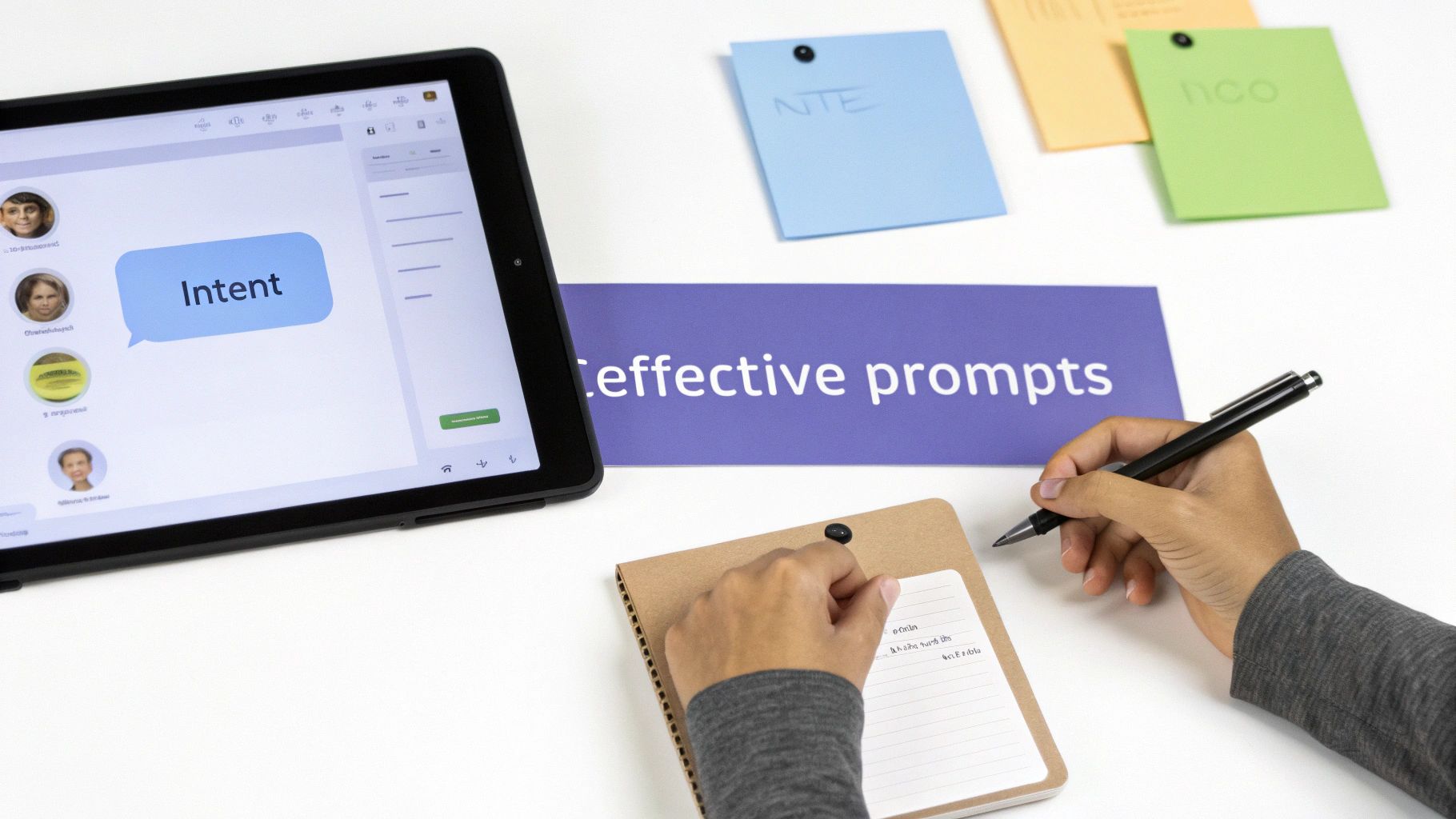
This isn’t just about barking orders at the AI. It's about meticulously shaping its personality, defining its boundaries, and mapping out every conceivable path a user might take. The real goal is to make interactions feel so natural that users forget they're talking to a machine.
Mapping User Journeys and Defining Intents
Before you even think about writing a prompt, you have to get inside your user’s head. What job are they "hiring" your chatbot to do? Are they trying to qualify a lead on your website? Get a straight answer to a complex support ticket? Or maybe just figure out how to use your product for the first time?
Each of these goals is a distinct user journey. And within each journey, you have to nail down the specific intents—the real purpose behind what a user types. For instance, when a user says, "my bill is wrong," their intent is clearly "billing_dispute." Pinpointing these intents is the foundation of a bot that truly understands, instead of just guessing.
- For Lead Qualification: The bot has to pick up on intents like
request_demo,pricing_query, orfeature_question. The flow should then smoothly guide them, pull key info like company size and job title, and then pass a warm, qualified lead to your sales team. - For Support Ticket Resolution: Here, the bot needs to recognize intents like
password_reset,order_status_check, ortechnical_issue. It then dives into a knowledge base or another system to fire back an instant answer or, failing that, create a ticket with all the context a human agent will need.
Crafting Prompts That Actually Work
Let's be blunt: a vague prompt gets you a useless, generic response. Effective prompt engineering is all about being ruthlessly specific, giving the model rich context, and setting crystal-clear boundaries. You need to give the LLM a well-defined role, a clear mission, and examples of what a "win" looks like.
Imagine you're building a support bot for your SaaS product. A lazy prompt like, "You are a helpful assistant. Answer the user's question," is a one-way ticket to frustration.
A strong prompt, on the other hand, is a detailed blueprint:
You are "SupportBot," a friendly and knowledgeable support agent for [Your Company]. Your tone is always patient and professional. Your one and only job is to solve user issues by referencing our internal knowledge base. If you cannot find a direct answer, you are forbidden from guessing. Instead, you must say: "I'm not able to find the answer to that right now, but I can create a support ticket for you. Would you like me to do that?"
See the difference? This prompt establishes a persona (SupportBot), dictates a tone, defines the only data source it can use, and provides a precise fallback action. That level of detail is what separates a world-class chatbot from a liability.
Don't Forget the Human Element
Building truly great chatbot conversations isn't just a technical challenge; it's a people problem that requires everyone to be on the same page. Your engineering team needs to live and breathe the latest AI-native tools and methods, and that doesn't happen by accident.
This is where you need to get serious about upskilling. AI workshops can bring developers up to speed fast. A workshop focused on using Claude for dev teams, for example, can standardize advanced prompting techniques across your organization. Likewise, training on a code-generation tool like Cursor can massively accelerate development and improve code quality. The point is to get your team thinking with AI, not just using it.
For an even faster injection of expertise, consider AI team augmentation. Dropping seasoned AI engineers directly into your squads creates an incredible knowledge-transfer loop. Your team learns best practices by doing, not by reading, working shoulder-to-shoulder with experts on your actual product. It’s the fastest way to bridge the skills gap and build the internal muscle you need to keep your chatbot evolving long after launch.
Getting Your AI Agent Ready for the Real World
This is it—the moment your blueprint comes to life. But getting your chatbot from a clever prototype to a production-ready AI agent is a lot more than just flipping a switch. It's about smart integration, a rock-solid deployment plan, and a serious commitment to security and scale.

This is where your bot stops being a simple conversationalist and starts being a powerful business tool that gets real work done. To do that, it needs to connect to the systems your business already runs on.
Empowering Your Team Through AI Augmentation
Before anything goes live, you need to get your team ready to own it. A huge mistake I see companies make is treating the chatbot as a fire-and-forget project. The most successful AI agents are the ones where the organization builds a lasting AI capability around them.
This is where you need to be strategic about talent. Forget the long, expensive hunt for some mythical "AI unicorn." A much faster and more effective route is AI team augmentation. You bring specialized AI engineers into your existing squads, which not only speeds up development but also creates a powerful knowledge-sharing loop. Your team levels up on the job, applying what they learn directly to your product.
With this approach, you're not just building a chatbot; you're building the in-house muscle to maintain and improve it for years to come. It’s a direct investment in your company's long-term AI competence.
The goal isn't just to deploy a bot. It's to create a sustainable AI ecosystem. Investing in your team's skills through augmentation and workshops is the most direct path there.
Another game-changing strategy is AI adopted engineers placements. This is where you strategically place a seasoned AI engineer inside a key project team. They become a force multiplier, guiding tough architectural calls, solving gnarly problems, and embedding best practices that elevate the entire team's game.
Accelerating Adoption with Targeted AI Workshops
For your AI initiatives to truly scale, that expert knowledge can't stay locked up with a few people. AI workshops are absolutely essential for getting everyone on the same page with the right tools and methods.
These aren't your typical boring training sessions. I'm talking about targeted, hands-on workshops focused on the tools your teams will actually use every single day.
- Workshops on Claude & Code for Dev Teams: These sessions are all about teaching developers how to use advanced models like Claude 3 for tricky reasoning and code generation tasks. You'll establish best practices for prompting and debugging, which keeps quality consistent across the board.
- Training on AI-Native Tools like Cursor: A workshop dedicated to a tool like Cursor can have an immediate, visible impact on developer productivity. It helps teams bake AI directly into their coding workflow, speeding up everything from writing boilerplate to creating complex algorithms.
- Sessions with Industry Experts (e.g., weavy.ai workshops): Bringing in outside experts can give your team a jolt of fresh perspective and introduce them to new techniques they wouldn't find on their own. This keeps everyone's skills sharp and in line with what's happening in the industry.
By investing in these workshops, you ensure every developer is speaking the same AI language. That alignment is what makes for smooth deployments, effective maintenance, and continuous innovation. For a deeper look at building these kinds of systems, check out our guide on custom AI agent development.
From Staging to Production with Confidence
Once your team is skilled up, you can tackle the technical deployment with a lot more confidence. The process should be methodical, moving from a controlled staging environment to a live production server. Setting up a CI/CD (Continuous Integration/Continuous Deployment) pipeline specifically for AI is non-negotiable here.
This pipeline automates the whole testing and deployment process, slashing the risk of human error. It guarantees that every single update to your model or its code is put through its paces before it ever gets in front of a user.
Finally, you have to plan for scale from day one. As your user base grows, your chatbot's infrastructure has to handle the extra load without breaking a sweat. This means using scalable cloud infrastructure and keeping a close eye on response times and system health. And of course, security is paramount—lock down every API endpoint and encrypt all sensitive data. It’s about protecting your business and your customers.
Empowering Your Team Through AI Augmentation
Getting your AI chatbot live is a huge win, but it’s really just the starting line. The technology is only one piece of the puzzle. Real, long-term value comes from building a team that can confidently own, iterate, and innovate on the AI you’ve just rolled out. This is the point where the focus shifts from the machine to the people behind it.
Think of it this way: this human-centric approach turns a one-and-done project into a durable competitive advantage. You're building an internal culture where AI knowledge flows freely, skills are constantly being sharpened, and your team feels empowered to push the limits of what your chatbot can achieve. Without this investment in your people, even the most sophisticated bot will eventually become a relic.
The market is simply moving too fast for a "set it and forget it" mentality. Globally, 80% of companies are already using or planning to use AI chatbots for customer service. The market itself is projected to rocket from $7.76 billion in 2024 to an incredible $27.3 billion by 2030. This breakneck pace means just having a bot isn't enough. The real winners will be the teams who can master and evolve their AI tools better and faster than everyone else.
Fostering an AI-First Culture with Strategic Placements
One of the fastest ways to get high-level AI expertise into your organization is through smart talent initiatives. Instead of spending months hunting for the perfect hire, you can jumpstart your team’s learning curve and project velocity almost overnight.
AI team augmentation is a game-changer. You embed specialized AI engineers directly into your existing development teams. These aren’t consultants dialing in from a distance; they're in the trenches with your crew, working on the same code and transferring critical knowledge through hands-on collaboration. It’s a fantastic way to de-risk complex AI projects while organically building up your in-house talent.
For your most critical projects, you might consider AI adopted engineers placements. This is where you bring in a senior AI architect or engineer to join a key team for a specific period. They become a force multiplier, steering architectural decisions, cracking the toughest technical nuts, and directly mentoring your people. This model works wonders when you're navigating the tricky waters of building a secure, scalable, production-grade AI agent.
Accelerating Adoption with Targeted AI Workshops
Great expertise can't live in a silo with just a few people. To really scale your AI efforts, you have to spread that knowledge across your entire engineering organization. Targeted, practical workshops are the best way to do this, standardizing best practices and making sure everyone is speaking the same language.
These workshops need to be all about practical application, focusing on the tools that will make a real difference in your team's daily grind.
- Claude & Code for Dev Teams: A workshop focused on using an advanced model like Claude 3 for complex code generation and reasoning can be a massive boost for development speed and quality. It gets everyone on the same page with effective prompting and debugging.
- AI-Native Tooling (e.g., Cursor): Running training sessions on AI-first code editors like Cursor helps developers weave AI directly into their coding flow. This speeds up everything from writing boilerplate to squashing complex bugs, leading to some serious productivity gains.
- Expert-Led Sessions: Bringing in outside experts for specialized training can provide a jolt of fresh perspective. They introduce your team to cutting-edge techniques they wouldn't find on their own, keeping their skills sharp and aligned with where the industry is heading.
The ultimate goal here is to shift your team from just using AI tools to truly thinking with them. This is the cultural leap that unlocks real innovation and transforms your chatbot from a static tool into a living, breathing asset.
This focus on people is what separates the companies that just deploy AI from those that truly master it. When your team is skilled and confident, they take ownership. They'll continuously optimize the bot's performance, refine its interactions, and find new business problems it can solve. You can learn more about how to get the most out of these systems in our article on AI agents for business. This is an investment in your people that pays dividends in continuous growth and improvement.
Common Questions About Building AI Chatbots
When you're diving into building a production-grade chatbot, a lot of questions pop up. It's not just about the code; founders and CTOs constantly have to weigh the tech against the business strategy. Let's tackle some of the most frequent questions I hear from teams on the ground.
How Do We Staff Up for a Major AI Project?
This is usually the first big roadblock. Let’s be real: hunting for specialized AI talent is a slow, painful, and brutally competitive process. Instead of putting your project on hold for months, smart teams are using more flexible ways to get the expertise they need right now.
One of the most effective moves I've seen is AI team augmentation. This is where you embed seasoned AI engineers directly into your current dev squads. They don't just build for you; they work alongside your people, transferring knowledge organically and dramatically speeding up your timeline. It’s a killer way to upskill your team without the long-term overhead of a full-time hire.
For those absolutely critical, make-or-break projects, another option is AI adopted engineers placements. You bring in a senior-level AI engineer for a defined period to act as a force multiplier. They'll steer the architecture, untangle the gnarly problems, and mentor your engineers, making sure your chatbot is built to last.
How Can We Standardize AI Skills Across Our Team?
Having one or two AI gurus on the team isn't going to cut it. To really move the needle, your entire engineering org needs to speak the same language and have a baseline set of skills. This is where you have to get serious about training.
Specialized AI workshops are perfect for this. They're not about high-level theory; they're about getting your team hands-on with the exact tools they’ll be using every day.
- Workshops on Claude & Code for Dev Teams: These sessions are gold. They teach your developers how to properly wield models like Claude 3 for heavy-duty coding and reasoning, drilling down on the best practices for prompting and debugging.
- Training on AI-Native Tools: Get your team into a workshop for an AI-first code editor like Cursor. This is a quick win that can immediately boost productivity by baking AI assistance right into their daily workflow.
- Expert-Led Sessions: Sometimes you need an outside perspective. Bringing in specialists through platforms offering weavy.ai workshops can expose your team to new techniques and make sure their skills are sharp and current.
Look, the goal isn't just to get your team using AI tools. It's to fundamentally change how they think, so they start thinking with AI. That's the cultural shift that unlocks real innovation and turns your chatbot from a static tool into a living asset.
Do We Need a Huge Budget to Get Started?
Honestly, no. The cost can swing wildly depending on the path you choose. Kicking things off with a managed service like OpenAI's API is way more budget-friendly than trying to stand up a massive self-hosted deployment from day one.
The smart play is to start small. Build a proof-of-concept, show some real ROI, and then scale your investment. Just make sure your initial spend is tied to a crystal-clear business goal.
How Do We Ensure the Chatbot Stays Up-to-Date?
A chatbot is a product, not a one-and-done project. Your knowledge base will go stale, and what users want today won't be what they want in six months. You have to build a continuous improvement loop right from the start.
This means getting into a rhythm of regularly checking conversation logs, pinpointing where the bot is falling down, and retraining the model with fresh data. The more you can automate this feedback process, the better your chances of long-term success. For more deep dives, tutorials, and what's new in the world of AI chatbots, the illumichat blog is a great resource.
Ready to build an AI agent that scales your business without scaling your headcount? AY Automate designs and deploys custom AI solutions that cut costs and supercharge productivity. Schedule your free automation audit today.


