An AI automation agency is your specialized partner for building custom "digital employees" for your business. This goes way beyond basic chatbots. We're talking about intelligent agents and automated workflows that plug directly into your operations, letting you scale productivity without bloating your payroll.
What Exactly Are AI Automation Agency Services?
Think of an AI automation agency less like a software vendor and more like a team of specialist engineers. Their whole job is to build intelligent systems that act like hyper-efficient employees, working 24/7 to take on the complex, repetitive tasks that eat up your team's valuable time. This includes placing AI-adopted engineers directly on your team, augmenting your staff with AI experts, and delivering hands-on AI workshops to upskill your developers.
This is a totally different way of thinking about software. You're not just buying a license for a tool; you're commissioning a bespoke operational capability. These agencies are the architects of your company's digital nervous system, weaving together all your different apps and data sources into one smart, seamless workflow.

Beyond Basic Chatbots to True Automation
Sure, a simple chatbot can answer a customer's question. But a true AI automation solution takes action. It runs multi-step processes on its own, right across your entire tech stack. The focus is squarely on creating real, tangible value for founders, CTOs, and operations leaders by fixing the bottlenecks that are holding you back.
This strategic power is what's fueling the explosive growth in this space. The AI agents market is on track to hit a staggering USD 182.97 billion by 2033, a huge leap from just USD 7.63 billion in 2025. That growth is coming from businesses just like yours demanding the exact kind of sophisticated automation these agencies deliver.
An AI automation agency's real value is its ability to translate your business problems into a technical solution. They don’t just hand you the AI; they build the connective tissue that makes it a productive part of your organization.
Core Service Offerings of an AI Agency
So, what do these services actually look like? They're always custom-fit to solve specific business problems, but they tend to fall into a few key categories that build on each other. These services are designed to embed AI expertise directly into your organization, giving you an immediate impact while building a long-term strategic advantage.
To give you a clearer picture, this table breaks down the core services and the business goals they're designed to hit.
Core Services Offered By an AI Automation Agency
| Service Offering | What It Achieves | Primary Business Goal |
|---|---|---|
| AI Engineer Placements | Fills a critical skills gap by embedding an AI expert directly into your team. | Accelerate project delivery and upskill your internal staff without a lengthy hiring process. |
| AI Team Augmentation | Provides a dedicated team of AI specialists to rapidly scale development capacity for large projects. | Tackle ambitious automation roadmaps and large-scale initiatives without the overhead of permanent hires. |
| Targeted AI Workshops | Delivers hands-on, practical training on specific AI tools and advanced language models. | Build in-house AI capability and empower your teams to solve problems more efficiently. |
Let's dive a little deeper into what each of these means for your business.
-
AI-Adopted Engineer Placements: Instead of going through a long, expensive hunt for a niche skillset, an agency can place a vetted AI engineer right on your team. This person is an expert in automation tools and acts as a force multiplier, speeding up your projects and leveling up your existing staff.
-
AI Team Augmentation: Got a huge project or need to scale your development power, fast? Agencies can provide a full team of AI specialists. This lets you take on ambitious automation roadmaps without the burden of permanent hires, giving you the flexibility to scale the team up or down as your needs change.
-
Targeted AI Workshops: Building your own in-house skills is critical. Agencies offer hands-on workshops on specific tools like Weavy.ai for integrations, Cursor for AI-powered coding, or advanced models like Claude. These sessions can completely change how your dev teams approach problem-solving and deployment. A great example of a specialized offering is AI webinar repurposing, which turns a single event into a mountain of marketing content.
Building Your In-House AI Capability
While having an agency build solutions for you is powerful, the real long-term win is building that power within your own walls. This isn't just about outsourcing a project; it's about fundamentally shifting your company's DNA to create a sustainable, in-house AI culture. The goal is to make your team the engine of innovation, and that starts by embedding the right expertise directly into your ranks.
This is where services like AI engineer placements and team augmentation come in. Instead of just handing over a finished product, an agency can place a highly skilled, AI-native engineer right inside your team. It completely changes the dynamic from a typical client-vendor relationship to a true partnership focused on building up your internal strength.

Why an AI-Adopted Engineer Is a Force Multiplier
There's a massive difference between a standard software developer and what we call an "AI-adopted" engineer. A generalist knows how to code, sure. But an AI-adopted engineer thinks in terms of automation, efficiency, and intelligent systems. They live and breathe the modern AI toolkit and see opportunities for its application where others simply don't.
For a CTO, bringing one of these specialists on board is like dropping a supercharger into your development engine. They don't just tick off tasks on a list; they elevate the performance of the entire team. They introduce new tools, mentor their colleagues on the fly, and establish the best practices needed to build AI systems that are scalable and easy to maintain.
A single, well-placed AI engineer acts as a catalyst. Their expertise spreads through your team by osmosis, transforming how your entire organization approaches problem-solving and innovation. It's the most effective way to upskill your current talent without pausing operations for formal training.
This approach gives you a clear path to not only speed up project timelines but also to ensure the complex AI systems you're building are actually understood and manageable by your own team for years to come.
Accelerating Growth With AI Team Augmentation
Sometimes, one specialist isn't enough. For bigger, more ambitious AI roadmaps, AI team augmentation delivers the raw horsepower you need to move at speed. Forget the slow and costly process of trying to hire an entire team of rare AI specialists. Instead, an agency can provide a ready-made unit of experts who plug directly into your existing structure.
This model is perfect for tackling major initiatives, such as:
- Developing a proprietary internal AI platform.
- Automating the core workflows of an entire business department.
- Migrating legacy systems over to a modern, AI-driven architecture.
Team augmentation provides the dedicated capacity to execute these large-scale projects without the long-term financial burden of permanent hires. It’s a flexible, potent way to scale your development capabilities exactly when you need them. You can get a better sense of the strategy by exploring our guide on how to implement AI in your business.
Practical Upskilling Through Targeted AI Workshops
Beyond direct placements, the best agencies empower your team through hands-on education. Targeted AI workshops are designed to deliver immediate, practical skills that your developers can start using the very next day. These aren't boring, theoretical lectures; they are deep dives into the tools that are completely redefining developer productivity.
Imagine a workshop focused on transforming your dev workflow. It might look something like this:
- Morning Session on AI-Native Coding: Your team learns to use Cursor, an AI-first code editor, to write, debug, and refactor code at a pace they never imagined possible.
- Afternoon Dive into LLMs: The focus shifts to advanced prompting techniques for models like Claude, teaching developers how to use it as an expert pair programmer for tackling complex logic and thorny problems.
- Integration Lab with Weavy.ai: The team gets hands-on experience using platforms like Weavy.ai to build and deploy in-app features rapidly, slashing integration time from weeks down to hours.
These workshops aren't just about learning a few new features. They're about installing a new mindset and equipping your developers with a standardized, hyper-efficient toolkit that raises the performance bar for your entire engineering organization.
Turning Your Developers into an AI-Powered Force
Sure, placing skilled engineers or augmenting your team can give you a quick win. But the real long-term victory comes from building a self-sufficient, AI-native engineering culture right within your own walls. This is where targeted, hands-on workshops move beyond PowerPoints and into real-world application. These sessions aren't about theory; they're designed to give your developers immediate, practical skills that completely change how they build, debug, and ship software.
It’s about sparking a permanent shift in how they think. Instead of treating AI as some far-off, complex field, developers learn to see it as a core part of their daily toolkit—just like their favorite IDE or version control system. The result isn't just a team that knows about AI, but a team that instinctively uses AI to solve problems faster and more creatively. This creates a standardized, high-efficiency way of working that scales across your entire organization.
The "Before and After" of an AI-Powered Workflow
To really get the impact, just picture a typical "before and after" for one of your developers. Before this kind of training, they might spend hours hunting down a complex bug, writing the same boilerplate code for the tenth time, or wrestling with a new API's documentation. Their workflow is solid, but it's capped by manual effort and old-school methods.
Now, imagine that same developer after a workshop. When a bug pops up, their first move is to open up a model like Claude and use it as an expert pair programmer, feeding it code snippets and asking for likely root causes. They use AI-native editors like Cursor to generate entire features from a simple prompt, turning hours of typing into minutes of focused, strategic direction. This doesn't just make them faster; it frees them up to think about the bigger picture.
The real ROI here isn't just about speed—it's about cognitive offloading. By letting AI handle the repetitive, mind-numbing tasks, you free up your most expensive engineering talent to focus on architecture, innovation, and building what actually makes your business unique.
For an engineering manager, this change is felt immediately. You'll see shorter development cycles, a clear jump in code quality, and a more engaged, proactive team.
The Core Toolkit for Modern Development
Our workshops don't throw every shiny new AI tool at your team. We focus on a curated set of tools that deliver the biggest and fastest productivity gains, tackling the most time-consuming parts of a developer's day.
Three tools form the foundation of these sessions:
- AI-Native Coding with Cursor: This isn't just another code editor; it's an environment built from the ground up for AI-driven development. We teach developers how to use it for everything from generating unit tests to refactoring legacy code with simple, natural language commands.
- Rapid Integration with Weavy.ai: Adding features like in-app chat or activity feeds can bog down a sprint for weeks. With a tool like Weavy.ai, developers learn to embed these complex features in a tiny fraction of the time, letting you ship new product value way faster.
- Advanced Problem-Solving with Claude: Models like Claude are more than just code-completion bots. Our training dives into advanced prompting, showing engineers how to use it as a brainstorming partner for designing algorithms, debugging tricky logic, and getting expert-level feedback on their code.
Once your team masters these, you've set a completely new baseline for what's possible. These skills don't just fade away; they become the new standard operating procedure. Find out more about how we structure these powerful sessions on our AI workshops for development teams page.
Building a Standardized AI Toolkit for Your Org
One of the biggest headaches for any engineering leader is inconsistency. When every developer uses their own pet tools and workflows, you end up with knowledge silos, brittle code, and a nightmare onboarding process. These workshops are the antidote.
By getting everyone fluent in the same core set of AI tools—like Cursor, Weavy.ai, and Claude—you establish a unified, best-practice approach. Suddenly, code reviews are faster because everyone's speaking the same language and working from the same playbook. Bringing new hires up to speed is a breeze because your AI-powered development process is clear and well-defined.
This standardization is about more than just efficiency; it's about building a culture of shared knowledge and continuous improvement. What you get is a more cohesive, adaptable, and confident engineering team, ready to take on bigger challenges without slowing down.
The Core Technology Powering Modern Automation
To really get what an AI automation agency does, you have to look under the hood. The magic isn't some single piece of software. It’s a carefully assembled engine built from a specific set of powerful, interconnected technologies. This is where custom AI agents—your tireless digital workers—come to life, executing complex, multi-step tasks around the clock with precision and speed.
These agents are built using a modern tech stack that blends the best of no-code flexibility with the power of custom development. It’s a pragmatic approach that delivers results fast without sacrificing scalability or security.
The Building Blocks of an AI Agent
Think of building an AI agent like putting together a high-performance car. You need a solid chassis, a powerful engine, and an intelligent navigation system. In the world of AI automation, this translates to specific platforms and models.
The core components usually include:
- A Workflow Automation Platform: This is the chassis. Tools like n8n and Make provide the visual, node-based framework to connect different applications and APIs. They act as the central nervous system, orchestrating the flow of data from one step to the next.
- A Powerful Language Model: This is the engine. Leading Large Language Models (LLMs) like GPT-4, Gemini, and Claude provide the cognitive horsepower. They handle the "thinking" tasks—understanding context, generating human-like text, and making decisions based on complex inputs.
- Custom Code for Precision: Sometimes, off-the-shelf connectors just don't cut it. Custom code (often Python or JavaScript) acts as the fine-tuning, allowing the agent to handle unique business logic or interact with proprietary systems. This ensures the solution is a perfect fit for your specific needs.
This combination creates a robust system that is both flexible and incredibly capable.
A Practical Example: An Automated Sales Qualifier
Let's see this tech stack in action. Imagine an AI agent designed to autonomously qualify new sales leads—a process that normally eats up hours of a sales rep's time.
Here’s how it works:
- Trigger: A new lead fills out a contact form on your website. This action kicks off an n8n workflow.
- Enrichment: The agent takes the lead's email and uses APIs to enrich the data, pulling company size, industry, and job title from external sources.
- Analysis & Decision: The enriched data is fed to a Claude model with a specific prompt: "Based on this lead's profile and our Ideal Customer Profile, score their qualification from 1 to 10 and explain your reasoning."
- Action: If the score is 8 or higher, the agent generates a personalized outreach email, schedules a follow-up in the CRM, and alerts the right sales rep on Slack. If the score is lower, it adds the lead to a nurturing sequence in your marketing platform.
All of this happens in seconds, without a single human click. This level of intelligent process automation frees your team to focus exclusively on high-value, qualified conversations.
The concept map below shows how different AI tools can work together to create these powerful workflows.
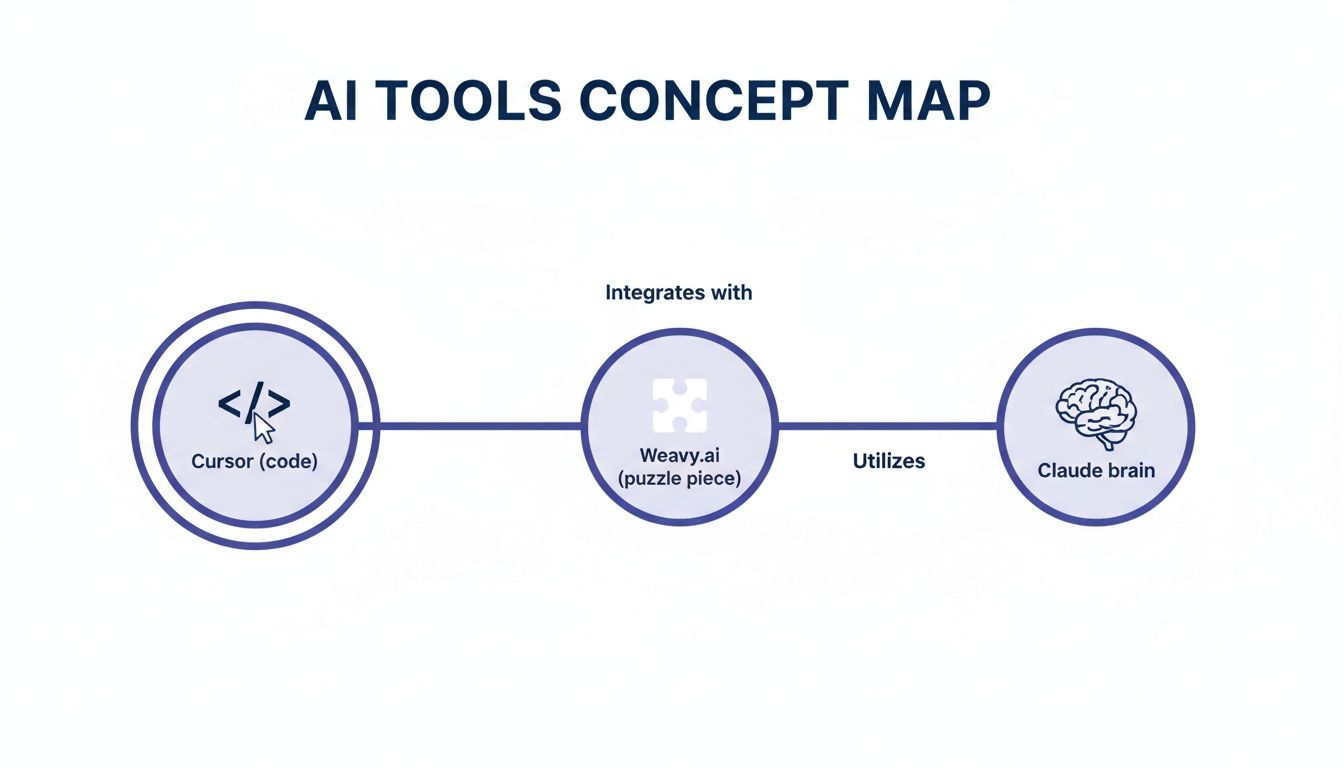
This visual shows a logical flow where development tools like Cursor feed into integration platforms like Weavy.ai, which then tap into the cognitive power of models like Claude.
The Security Advantage of Self-Hosted LLMs
For many businesses, especially those in regulated industries like finance or healthcare, data security is non-negotiable. Sending sensitive customer data or proprietary info to a third-party API is often a non-starter. This is where self-hosted LLMs become a game-changer.
By deploying an open-source model (like Llama 3 or Mistral) inside your own private cloud or on-premise infrastructure, you gain complete control.
A self-hosted model ensures that your company's most sensitive data never leaves your secure environment. This eliminates the primary security risk associated with public AI services, giving you all the power of modern AI without compromising on privacy or compliance.
This approach is crucial for CTOs and security officers who need to maintain strict data governance. It provides a path to adopt powerful AI automation while sticking to regulations like GDPR or HIPAA. An expert AI automation agency can manage the entire deployment process, making this high-security option accessible.
The demand for these secure, intelligent systems is a key reason the agentic AI market is projected to surge from USD 7.29 billion in 2025 to an incredible USD 139.19 billion by 2034, according to Fortune Business Insights. This explosive growth reflects an urgent need for agencies that can deliver production-grade automations using tools like n8n and modern LLMs to help businesses scale operations and cut costs.
How To Choose The Right AI Automation Partner
Picking the right AI automation partner is a big deal. It’s a decision that goes way beyond a flashy sales pitch or a slick website. You're not just buying a piece of software; you're bringing on a team that will fundamentally reshape how your business operates.
The goal is to find a partner who feels like an extension of your own team. They need to get in the trenches with you, truly understand your biggest headaches, and build solutions that don’t just work today but keep delivering value for the long haul.
This means you have to look past the surface-level promises. A real partner’s process starts with a deep-dive audit to pinpoint the best automation opportunities and ends with ongoing support and training for your team. It’s this end-to-end approach that separates the one-off vendors from the true strategic partners.
Vetting Technical Expertise and Proven Results
First things first: you need to pop the hood and check their technical chops. A serious agency’s portfolio should be packed with projects built on production-grade tools. Look for experience with workflow automation platforms like n8n and Make, as these are the nuts and bolts of connecting different systems and orchestrating complex business processes at scale.
But tools are only half the story. The real proof is in the results. Vague claims about "boosting efficiency" are just noise. You want to see hard numbers. A top-tier agency will have case studies with concrete KPIs, showing exactly how they solved a real business problem. Think things like: "slashed lead qualification time by 90%" or "cut operational costs by 40%."
Honestly, the same rules for how to choose a software development company apply here. It all comes down to digging into their track record and seeing tangible, proven outcomes.
Prioritizing Security and Data Privacy
When you start talking about AI, security has to be front and center. This is especially true if you’re handling sensitive customer data or your own secret sauce.
A crucial question for any potential partner is how they handle data privacy. The gold standard here is deploying self-hosted LLMs. This approach means your data never leaves your own private cloud or on-premise servers, giving you complete control.
An experienced agency will be comfortable setting up these secure deployments, giving you all the power of modern AI without forcing you to compromise on compliance or data security. For any business in a regulated industry, or for anyone who values their intellectual property, this is a non-negotiable.
A partner's commitment to security isn't a feature; it's a foundational requirement. Ask them to detail their security protocols, from data encryption standards to access control policies, to ensure they meet your organization's stringent requirements.
Assessing the Strategic Partnership Model
At the end of the day, you're looking for more than a vendor who just executes tasks. You need a strategic partner who is genuinely invested in your success. The right agency won’t just build a solution and toss it over the fence.
They’ll work with you to create a strategic roadmap, laying out a phased plan for automation that lines up perfectly with your bigger business goals. This is how you know they're thinking about your long-term growth, not just closing out the current project.
A solid partnership model should always include:
- Comprehensive Discovery Audits: A thorough investigation of your current workflows to find the juiciest automation opportunities.
- Strategic Roadmapping: A clear, step-by-step plan that shows how automation will be rolled out over time for maximum impact.
- Ongoing Optimization: A promise to keep monitoring and tweaking the AI systems after launch to make sure they’re always running at peak performance.
- Team Training and Empowerment: Hands-on workshops and training to get your own people comfortable with the new tools, building AI skills in-house.
This kind of all-in engagement model is the clearest sign that an agency is focused on creating lasting business value. The market for AI agents is projected to explode from USD 7.84 billion in 2025 to USD 52.62 billion by 2030, showing just how much value these systems are creating. Your partner needs to be ready to guide you through this fast-moving space, especially in hot areas like multi-agent systems and specialized AI for sales and development. You can dig into the numbers yourself with market projections for AI agent technology at MarketsandMarkets.
Still Have Questions? Let's Clear a Few Things Up
It's natural to have questions when you're thinking about bringing this level of automation into your business, especially when it involves your own team. Here are a few common ones we hear from leaders who are ready to build up their internal AI muscle.
How Do You Place the Right AI Engineer in Our Team?
Finding an expert who clicks with your team and understands your technical world is everything. It’s never about just filling a seat. Our process starts with a serious deep dive into your current projects, the tech stack you’re running, and the exact skills you’re missing to hit your goals. We're not just looking for a developer; we're looking for an AI-adopted engineer who instinctively sees opportunities for automation.
This means we’re vetting for more than just Python or n8n expertise. We look for hands-on experience with modern AI development environments like Cursor and a deep familiarity with models like Claude. This holistic approach ensures the engineer we place doesn't just slot in—they act as a force multiplier, upskilling your existing team from the moment they start.
What Is AI Team Augmentation and When Do We Need It?
Think of AI team augmentation as your on-demand AI strike team. It’s the perfect fit when you have a massive AI project on the horizon but simply don’t have the internal bandwidth to pull it off quickly. Instead of just one person, we provide a complete, pre-vetted team of specialists—developers, project managers, you name it—who plug right into your organization and hit the ground running.
This is the way to go when you're:
- Building out a large-scale internal AI platform.
- Automating an entire department's core operations.
- Trying to execute a complex project under a tight deadline.
Team augmentation gives you the specialized firepower you need for big moves, without the long-term overhead or the headache of recruiting an entire team from scratch.
How Do AI Workshops Transform Developer Productivity?
Our AI workshops are designed to spark a fundamental shift in how your development team builds things. These aren't your typical sit-and-listen lectures. They are intense, hands-on sessions focused on practical tools that deliver immediate productivity boosts. The whole point is to standardize a high-performance AI toolkit across your entire engineering org.
The real win here is getting developers to move from simply writing code to architecting intelligent solutions. Once they master tools like Cursor for AI-native coding and Claude for complex problem-solving, they start offloading the repetitive grunt work and can finally focus on genuine innovation.
For instance, a workshop might zero in on using Cursor to generate, refactor, and debug code with plain English commands. Another session could be a deep dive into using Claude as an expert pair programmer to untangle tricky logical problems. We also get our hands dirty with rapid integration tools like Weavy.ai, teaching teams how to build and ship sophisticated features in a matter of hours, not weeks. This practical training makes the skills stick, embedding them into your team's daily workflow for a real, sustainable edge.
Ready to see how custom AI solutions can scale your operations without scaling your headcount? AY Automate offers a free automation audit to identify the highest-impact opportunities in your business. Book your free audit today.