
At its core, qualifying sales leads is all about sorting through prospects to find the ones most likely to buy. It's the filter that makes sure your sales team is spending their precious time on high-value opportunities, not just spinning their wheels. This usually means measuring a lead against your Ideal Customer Profile (ICP) and gauging their engagement, often with frameworks like BANT or MEDDIC. For anyone selling specialized tech services—like AI adopted engineer placements or AI workshops for dev teams—this process isn't just nice to have; it's absolutely critical.
Stop Wasting Time on Unqualified Tech Leads

Let’s be honest for a second. The vast majority of inbound leads for high-ticket services—like AI team augmentation or placing AI-adopted engineers—are never going to close. They download a whitepaper, fill out a form, and then vanish into thin air.
This leaves your sales team chasing down contacts who have no real budget, no authority to make a decision, and no immediate need. It’s not just frustrating; it's a silent killer of productivity and a drain on your most valuable resources.
Every hour a senior sales rep spends vetting a low-quality lead is an hour they aren't spending with a high-value client who's ready to sign. This isn't just a hunch; the data backs it up. Recent B2B benchmarks reveal that a staggering 75% of marketing-generated leads don't make the cut for sales, and a shocking 79% of those never convert into actual revenue.
It gets worse. Sales teams end up wasting about 32% of their time chasing these dead ends. Think about that. They're spending nearly a third of their week on leads that will go nowhere, instead of focusing on the golden 25% with real potential.
The True Cost of a Leaky Funnel
Picture this: an agency specializes in placing AI-adopted engineers and offers bespoke workshops on advanced tools like Claude and Cursor for dev teams. Their marketing efforts pull in 100 leads a month. Without a solid qualification system, their sales team diligently follows up with every single one.
What happens next? They spend weeks on the phone with junior developers who can't sign a check, project managers on fishing expeditions, and companies whose tech stack is nowhere near ready for AI. All the while, a CTO from a well-funded startup—actively looking for AI team augmentation—gets lost in the noise and ends up signing with a competitor.
This scenario isn't hypothetical; it plays out every day. The costs are very real:
- Wasted Sales Hours: Your most expensive people get bogged down in administrative tasks instead of doing what they do best: selling.
- Missed Opportunities: The truly great leads, the ones ready to buy now, slip through the cracks because your team is too busy to follow up quickly.
- Inaccurate Forecasting: A pipeline stuffed with unqualified leads gives you a false sense of security and makes predicting revenue a guessing game.
- Sales Team Burnout: Nothing kills morale faster than constant rejection and fruitless conversations. It's a fast track to high employee turnover.
Shifting to an Intelligent Qualification Engine
The solution isn't about working harder; it's about working smarter. The real game-changer is moving from manual, time-consuming vetting to an intelligent, automated qualification process. This is how you turn your sales funnel from a leaky bucket into a predictable revenue engine. This guide is going to show you exactly how to build it.
An effective lead qualification system is your gatekeeper. It ensures that only the most promising opportunities ever reach your sales team. It’s a shift from focusing on the quantity of leads to the quality—and for a tech-focused business, that shift is everything.
You'll learn to build a system that goes beyond just collecting contact info. It will automatically identify leads who match your ICP, show clear buying intent, and are genuinely ready for a serious conversation.
To really get this right, you need a solid foundation. For a deeper look at the nuts and bolts, it's worth exploring a practical framework for qualifying sales leads. Mastering this approach is how you scale your business without having to scale your sales team at the same frantic pace.
Manual vs AI-Powered Lead Qualification
Let's break down the real-world impact of making this shift. The difference between a sales team manually sifting through leads and one powered by an automated AI system is stark, both operationally and financially.
| Metric | Manual Qualification | AI-Powered Qualification |
|---|---|---|
| Time to Qualify | 24-48 hours | <5 minutes |
| Cost per Lead Qualified | $50 - $100 (sales rep time) | $1 - $5 (API calls, automation) |
| Sales Rep Time Spent | ~32% on non-sales tasks | <5% on non-sales tasks |
| Lead Follow-Up Speed | Slow, inconsistent | Instant, 24/7 |
| Qualification Accuracy | Subjective, prone to error | Objective, data-driven |
| Opportunity Cost | High (missed deals) | Low (high-potential leads prioritized) |
The numbers don't lie. Automating this process not only frees up a massive amount of your sales team's time but also drives down costs and ensures you never miss out on a hot lead again. It’s a clear win across the board.
Define Who You’re Actually Selling To

Before you write a single line of automation code or touch a workflow builder, you have to get brutally honest about who you're trying to sell to. If your picture of the ideal client is fuzzy, your qualification process will be too. All you’ll accomplish is talking to the wrong people, just faster.
Learning how to qualify sales leads with any real precision starts with a data-driven Ideal Customer Profile (ICP). This is non-negotiable.
For a high-tech service—like AI team augmentation or specialized AI workshops—a generic ICP based on company size and annual revenue is practically useless. You have to dig much, much deeper. You need to look for the signals that a company is actually ready, willing, and able to spend money on advanced AI solutions.
Moving Beyond Surface-Level Firmographics
Your absolute best customers share specific traits that you won't find on a standard company profile. I'm talking about the technographic and psychographic details that reveal a genuine appetite for AI adoption. The goal here is to build an ICP that serves as the blueprint for your perfect customer.
So, what are the real indicators of a good fit? Think about what separates a tire-kicker from a true buyer:
- Technographics: What tech are they already using? A company limping along with legacy systems is a world away from one whose developers are already playing with tools like Cursor or using Claude for coding help. You're looking for evidence of a modern, forward-thinking tech stack.
- Team Structure: How is their engineering team organized? The presence of roles like "Head of AI" or "ML Ops Engineer" screams strategic commitment. It tells you they're serious about this, not just chasing a trend.
- Hiring Patterns: Are they actively posting job descriptions for AI-centric roles? This is one of the clearest buying signals you can find—it points directly to both need and allocated budget for AI engineer placements.
- Content Consumption: What are their leaders reading? Are they downloading whitepapers on LLM implementation? Attending webinars about AI-driven development? This shows where their heads are at.
Your ICP isn't just a document for the marketing team. It's the core logic of your entire automated qualification engine. A sharp ICP ensures every single step that follows—from data enrichment to lead scoring—is laser-focused on finding buyers who look exactly like your most profitable customers.
Adapting Classic Frameworks for High-Tech Sales
Old-school sales frameworks like BANT (Budget, Authority, Need, Timeline) aren't dead, but they desperately need a modern, tech-focused translation. When you're qualifying leads for niche services like placing AI-adopted engineers or running AI workshops, the questions you ask have to be different.
Let's see how this plays out by adapting BANT for a company that sells AI workshops to development teams.
A Modern BANT for AI Services
| Framework Element | Traditional Question | AI-Specific Qualification Question |
|---|---|---|
| Budget | Do you have a budget for this? | Have you allocated funds for professional development or R&D initiatives this quarter? |
| Authority | Are you the decision-maker? | Who owns the technical enablement strategy for the engineering team? |
| Need | What problem are you trying to solve? | Are your development cycles slowing down because of a skills gap in modern AI tools like Claude & Cursor? |
| Timeline | When are you looking to implement? | Is there a specific project deadline that requires your team to get up to speed on AI quickly? |
See the difference? This simple shift turns a generic sales pitch into a highly relevant conversation. You're immediately hitting on the specific, high-stakes pain points that CTOs and VPs of Engineering are losing sleep over right now.
From Theory to Actionable Criteria
Okay, the final piece is to translate all this deep understanding into a simple, actionable checklist. This becomes the rulebook your automation will follow to sort the wheat from the chaff. You’re moving from abstract ideas to concrete, verifiable data points that a machine can easily check.
For a lead looking into AI team augmentation, your qualification checklist might look like this:
- Company Size: 50-500 employees. They’re big enough to have a real budget but small enough to move quickly.
- Funding: Has raised a Series A or later funding round in the last 18 months. This is a strong proxy for available cash.
- Tech Stack: Publicly uses Python, Kubernetes, and at least one major cloud provider (AWS, GCP, Azure).
- Hiring Signal: Has open roles for "Machine Learning Engineer" or "Data Scientist" on their careers page.
- Contact Role: The initial inquiry comes from a VP of Engineering, CTO, or a similar senior technical leader.
With this level of clarity, the guesswork is gone. You now have a precise, repeatable definition of a qualified lead. This is the foundation you need to build an automated scoring model that finds these buyers with ruthless efficiency.
Build a Lead Scoring Model That Actually Finds Buyers
Okay, so you've nailed down exactly who you're selling to. That's a huge first step. Now, let's turn that Ideal Customer Profile (ICP) into a smart, dynamic scoring system that does the heavy lifting for you.
A generic, out-of-the-box lead scoring model is worse than useless. It's a recipe for disaster, sending your sales team on wild goose chases after people who look good on paper but have zero actual buying intent.
The goal here is to build a model that understands the unique signals of a technical buyer. It’s about learning to weigh different data points correctly, so your system can automatically surface the leads who are genuinely ready for a conversation about AI engineer placements or team augmentation.
The Two Sides of the Coin: Explicit vs. Implicit Data
A truly effective scoring model is a blend of two different types of information: what your leads tell you directly, and what their actions reveal.
- Explicit Data: This is the stuff they hand over on a silver platter. Think job titles (CTO, VP of Engineering), company size, industry, and even technographic details like the specific tools in their tech stack. This data is your first pass at confirming they fit your ICP.
- Implicit Data: This is all about behavior. It’s where you uncover their real interests and engagement level. Did they just download a top-of-funnel ebook? Or did they spend an hour in an advanced, hands-on workshop focused on using Claude for development teams? The difference is massive.
The real magic happens when you bring these two together. A "Director of Engineering" (explicit) from a 200-person tech company who also attended your "AI Adoption for Dev Teams" webinar (implicit) is a far hotter lead than a CEO who just downloaded a generic whitepaper. To get this right, you'll need the best data enrichment tools to fill in the gaps and give your model the full picture.
Putting Points on the Board
This is where the rubber meets the road. You’re translating your ICP and buyer journey into a simple, points-based system. The entire game is about assigning higher values to the actions and attributes that are tightly correlated with a closed deal.
Don’t overcomplicate this at the start. You can always refine it later.
For a company offering AI team augmentation, your scoring might look something like this:
| Data Type | Attribute or Action | Point Value |
|---|---|---|
| Explicit | Job Title: C-level Tech Exec (CTO, VP Eng) | +25 |
| Job Title: Director or Manager Level | +15 | |
| Company Size: 50-500 employees (ICP fit) | +10 | |
| Tech Stack: Uses modern tools (e.g., Cursor) | +15 | |
| Implicit | Attended "Claude for Devs" workshop | +30 |
| Requested pricing for AI engineer placement | +40 | |
| Viewed case study on AI team augmentation | +20 | |
| Visited careers page (hiring signal) | +10 |
This approach instantly separates the curious browsers from the serious prospects. The person who requests pricing for an AI engineer is signaling a much more urgent need than someone who just skimmed a blog post.
Focusing on quality like this is critical. It turns out poor lead qualification is behind a staggering 67% of all lost sales opportunities. But when you get it right, high-quality leads completely flip the script—a structured scoring process can lift your lead ROI by 77%.
Common Traps to Sidestep
Look, building your first lead scoring model is an iterative process. You will not get it perfect on day one. But you can sidestep the common pitfalls that derail most teams right out of the gate.
- Setting the Bar Too High (or Low): If your MQL threshold is too high, your sales team will be starved for leads. Too low, and they'll drown in unqualified contacts who waste their time. Start with a reasonable baseline and adjust it based on the actual conversion rates you see.
- Forgetting to Subtract Points: Not all actions are created equal. A student downloading every piece of content might rack up a huge score but has zero buying power. You need negative scoring. Assign negative points for things like unsubscribing, having a personal email address (
@gmail.com), or visiting your jobs page to apply for a role. - Failing to Evolve the Model: Your ICP and market are not static. The signals that predicted a sale six months ago might be less relevant today. You have to create a feedback loop where your sales team’s real-world insights are fed back into the model to refine point values every quarter.
A lead scoring model is not a "set it and forget it" tool. It’s a living system that needs to be fed with real sales data—wins and losses—to get smarter and more predictive over time. A static model is a dying model.
By carefully assigning values and constantly refining your system with real-world feedback, you build a powerful engine that automatically flags your best buyers. This frees up your sales team to spend their time on what actually matters: closing deals with clients who desperately need your expertise.
For more on creating efficient workflows, check out our guide on marketing automation best practices.
Alright, let's get that scoring model you just built working for you around the clock. The theory is solid, but the real magic happens when you put it on autopilot. This is where we move from a spreadsheet to a living, breathing asset that qualifies leads 24/7.
We're going to dive into how you can build an automated qualification workflow with accessible tools like n8n and power it up with Large Language Models (LLMs).
This isn't your standard, clunky email sequence. We're talking about a custom-built AI agent that can think, pull in extra data, and make smart calls on who your sales team should be talking to right now. These specialized agents are surprisingly effective. One recent benchmark showed a purpose-built Sales Qualification Agent beat a general tool like ChatGPT by 6% in research, a massive 20% in personalized outreach, and 16% in engaging prospects. It’s a clear sign that tailored automation wins.
Building a Practical AI Qualification Workflow
Let's make this real. A Chief Technology Officer from a 250-person tech company just downloaded your new case study, "Scaling Development Teams with AI-Augmented Engineers."
This is a huge buying signal. But instead of letting that lead get cold in a CRM queue, your AI agent springs into action the second it happens. The workflow instantly starts piecing together a profile to figure out if this CTO is a hot lead that needs a call today.
Here's the basic flow of what happens behind the scenes.
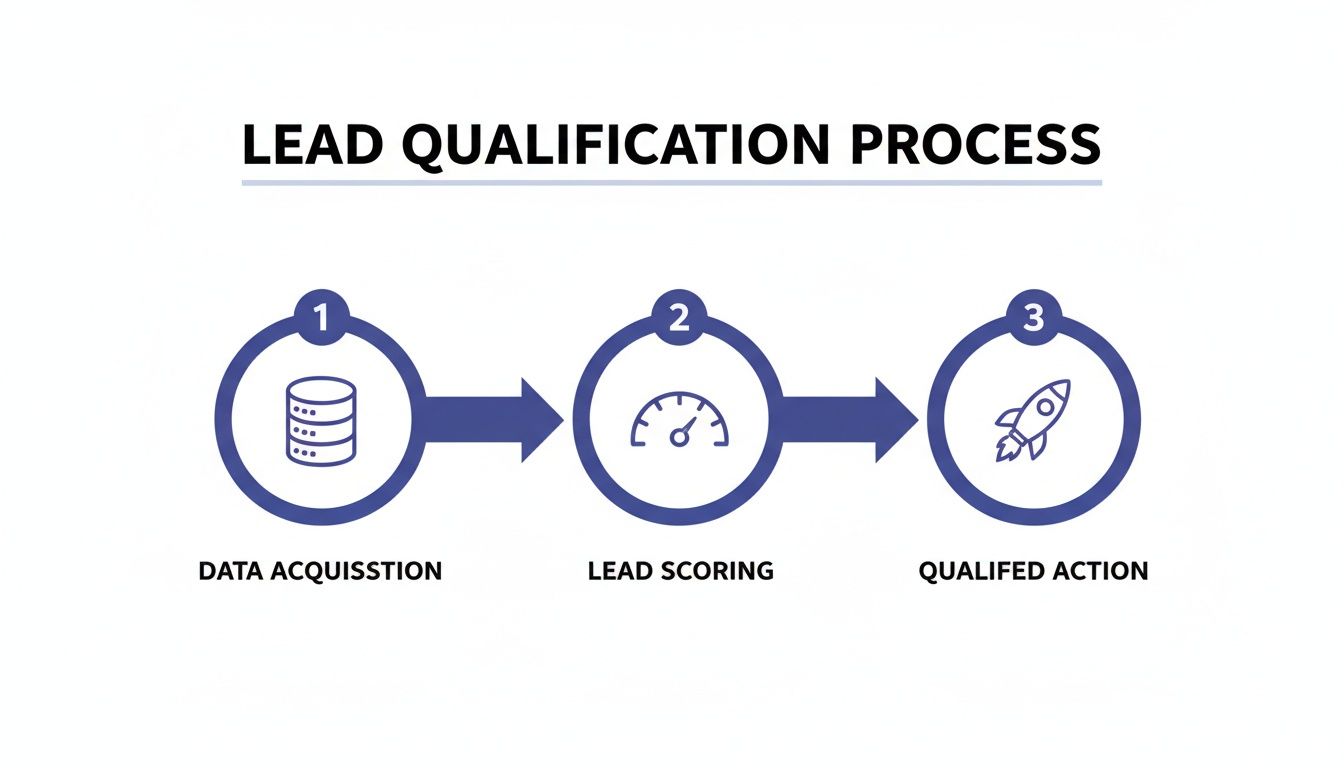
It’s a simple but powerful loop: grab the data, run it through your scoring logic, and then trigger the right action.
Anatomy of an AI Lead Qualification Agent
To build this, you'll need to string together a few services inside an automation platform. Tools like n8n or Make.com give you a visual canvas to connect different apps without being a hardcore developer. Think of it as building a digital assembly line for your leads.
The goal is to get enough context to make a solid decision, automatically. Your agent isn’t just ticking boxes; it’s building a story around each lead. If you want to go deeper on this concept, check out our guide on custom AI agent development.
So, what does this actually look like in practice? Here’s a simplified breakdown of the workflow that would handle our CTO lead, built in n8n.
Example AI Lead Qualification Workflow in n8n
This table shows how different tools, or "nodes" in n8n, work together to turn a raw form submission into a sales-ready opportunity.
| Step | Tool or Node | Action | Outcome |
|---|---|---|---|
| 1 | Webhook / Form Trigger | Captures the new lead from the case study download form. | A new workflow starts with the CTO's basic contact info. |
| 2 | Data Enrichment API | Pings a tool like Apollo.io or Clearbit to find company and contact details. | The lead is enriched with company size, funding, and industry data. |
| 3 | LinkedIn Scraper | Scans the lead's public LinkedIn profile for their job history and skills. | Gathers crucial details on their technical background and seniority. |
| 4 | LLM (Claude/GPT-4) | Analyzes the company's "Careers" page for AI-related job postings. | Identifies active hiring signals—a strong indicator of need and budget. |
| 5 | Scoring Logic | Applies points from your lead scoring model based on all enriched data. | A final qualification score (e.g., 85/100) is calculated. |
| 6 | Router / If-Node | Checks if the score is above your MQL threshold (e.g., 75 points). | The lead is routed down a "hot" or "nurture" path. |
| 7 | CRM & Slack | If "hot," it creates a deal in your CRM and pings a senior sales rep. | The sales team gets a real-time alert with a complete lead profile. |
This whole process executes in under 60 seconds.
What you just saw takes a sales development rep a good 20-30 minutes of manual digging to accomplish. This isn't just about being faster; it's about being relentlessly consistent and making sure a perfect lead never gets missed.
Why This Approach Is a Game-Changer
When you automate qualification with AI, you completely change the game for your sales team. They stop being prospectors digging for gold and become expert closers who only engage with pre-vetted, high-intent buyers.
- Speed to Lead: A hot lead gets a personalized touch within minutes, not days. This single factor can dramatically increase your engagement rates.
- Deeper Insights: Reps walk into the first call armed with a full data profile—including hiring signals and tech stack info—letting them skip the boring discovery questions and have a real conversation.
- Scalability: This system handles 100 leads just as easily as it handles 10, all without adding headcount. It’s a true force multiplier.
This is how you turn the theory of lead qualification into a powerful engine that enriches, scores, and routes your best prospects to the right people, building your pipeline while you sleep.
Measure What Matters and Refine Your Process
Building an AI-powered qualification engine is a huge step, but it’s really only half the job. An automated system you can't measure is just a black box, and hope isn't a strategy. To really know if it's working, you have to track the right Key Performance Indicators (KPIs) and build a system for constant improvement.
This isn't about chasing vanity metrics, like the raw number of leads you've processed. We need to focus on the numbers that prove your engine is actually driving revenue and making your sales team’s life easier.
KPIs That Reveal True Performance
To get a clear picture of what your AI agent is actually worth, you need to look past the surface-level data. Here are the core metrics that tell the real story of how well your automated lead qualification is performing.
- Lead-to-SQL Velocity: How long does it take for a new lead to become a Sales Qualified Lead (SQL)? A sharp drop here is a massive win. It shows your AI is spotting high-intent prospects and getting them to your sales reps way faster than any manual process ever could.
- Pipeline Contribution: What percentage of your sales pipeline is being generated by AI-qualified leads? A healthy, growing number proves the system isn't just busy—it's actively sourcing real, valuable opportunities.
- Conversion Rate (SQL-to-Close): This is the ultimate test. You need to compare the close rate of leads qualified by your AI agent against those you sourced manually. If the AI-qualified leads have a higher conversion rate, you have direct proof that your model is doing its job.
- Sales Cycle Length: Track the average time it takes for an AI-qualified lead to go from the first touch to a closed-won deal. A shorter sales cycle means your reps are starting conversations with better-informed, more motivated buyers from the jump.
Creating a Powerful Feedback Loop
Data tells you what is happening, but it’s your sales team that can tell you why. Their real-world conversations are the ultimate source of truth. Capturing this qualitative feedback is non-negotiable for refining everything from your ICP to your scoring model.
An automated system that doesn’t learn from human experience is doomed to fail. The trick is to formalize the feedback process so that insights from the front lines are consistently fed back into the system to make it smarter.
Your AI qualification model isn't a "set it and forget it" project. It's a living system that must be constantly tuned with fresh data and human insights. The moment you stop refining it is the moment it starts becoming obsolete.
Establishing a simple Service Level Agreement (SLA) between marketing and sales is a great place to start. This document defines what a qualified lead actually is and sets clear expectations for how quickly sales must follow up. It’s all about creating shared accountability.
Example SLA Template Section
| Item | Definition & Expectation |
|---|---|
| MQL Definition | A lead scoring 75+ points, with an enriched profile showing a title of Director or higher in a company with 50-500 employees. |
| Sales Follow-Up Time | Sales must contact any AI-qualified lead within 4 business hours of receiving the notification in the CRM. |
| Feedback Requirement | Sales must update the lead status to "Accepted," "Rejected," or "Nurture" within 24 hours, with a clear reason for rejection. |
The Rhythm of Refinement
Finally, you need to get a regular meeting on the calendar—bi-weekly is a good rhythm to start with—that includes key players from both sales and marketing. This isn't just another status update; it's a strategic workshop.
Keep the agenda simple and focused:
- Review the Numbers: Look at the core KPIs together. Where are you winning? Where are the bottlenecks?
- Analyze Rejected Leads: Dig into the leads that sales marked as "Rejected." Was the data wrong? Did the lead's needs not match? This is where you uncover the flaws in your scoring logic.
- Share Anecdotal Insights: What are reps hearing on calls? Are certain pain points coming up more often? This qualitative feedback is gold for tweaking your ICP and automation workflows.
This continuous cycle of measuring, gathering feedback, and refining is how you build a truly world-class system for qualifying sales leads. For a deeper look into the metrics that drive growth, you might be interested in our guide on how to measure operational efficiency.
Common Questions About AI Lead Qualification
Even with a solid plan, bringing AI into your qualification process is bound to stir up a few questions. This is especially true for CTOs, founders, and sales leaders in highly specialized B2B services—like placing AI-adopted engineers or AI team augmentation. Let's dig into some of the most common things that come up.
How Much Technical Skill Is Really Needed to Build These AI Workflows?
That's a fair question, particularly for teams that aren't sitting on a bench of dedicated developers. The good news is that modern automation platforms like n8n and Make have seriously lowered the barrier to entry. You definitely don’t need to be a senior engineer to get powerful qualification workflows up and running.
A basic grasp of how APIs talk to each other is helpful, but a lot of the work is done in a visual, drag-and-drop environment. That said, when it comes to building production-grade, highly secure AI agents, we've got you covered either way.
- Managed Service: We can design, build, and deploy the entire thing for you. Think of it as a fully managed service where we handle all the technical heavy lifting so you can focus on your business.
- Team Empowerment: We also run hands-on AI workshops designed for your dev team. These sessions are all about upskilling your own people on powerful tools like Claude for coding and modern editors like Cursor, giving you the ability to build and maintain this capability in-house.
What Is the Real ROI on Automating Lead Qualification?
When you’re selling high-value services like AI team augmentation, the return on investment really pops in three key areas.
First, efficiency. Your senior reps stop burning hours on manual research and chasing leads that go nowhere. We’ve seen sales productivity jump by over 30%, freeing them up to spend their time in high-value conversations with people who are actually ready to buy.
Second, speed. Your sales cycle gets shorter because your team is only engaging with high-intent leads who are a perfect technical and business fit. An AI agent can qualify a new lead in under a minute, which means you’re almost always the first one to get back to a hot prospect.
Third, revenue growth. By pushing up conversion rates and getting deals through the pipeline faster, you can grow your top-line revenue without just hiring more salespeople. Think about it: when a rep gets 10 hours back every week, that’s over 500 hours a year they can spend closing deals instead of digging for them.
Can AI Really Handle the Nuances of a Complex Tech Sale?
This is where modern LLMs have completely changed the game. A simple keyword-based automation is dumb; it has no concept of context. A custom AI agent, on the other hand, is built for it. For example, you can't properly qualify a lead for an AI adopted engineers placement just by looking at their job title.
The AI isn't here to replace the human relationship in a complex sale—it's here to supercharge it. The AI handles the grunt work of data enrichment and initial qualification at scale, freeing up your best salespeople to apply their expertise where it matters most: with the most promising opportunities.
Our agents can be trained to look at a lead's public profile and understand the strategic importance of their role, not just the title on their LinkedIn. It can parse recent activity to pick up on specific buying signals related to AI adoption, like their company posting jobs for ML engineers or their team attending workshops on new AI development tools.
This level of nuance is what makes the difference. In fact, purpose-built sales agents have been shown to beat general models like ChatGPT by 6% in research, 20% in personalized outreach, and 16% in actually engaging prospects. The AI does the initial heavy lifting with precision, so your sales team can walk into conversations that are already three steps ahead.
Ready to stop wasting time on unqualified leads and build a predictable revenue engine? The team at AY Automate designs and deploys custom AI agents that enrich, score, and route your best prospects 24/7. Find out how we can help you scale without increasing headcount.